Chapter 1 · The Mind
The Gadget Trap
How a small glowing screen became the master of your mind — and the oldest, simplest way to take the throne back.
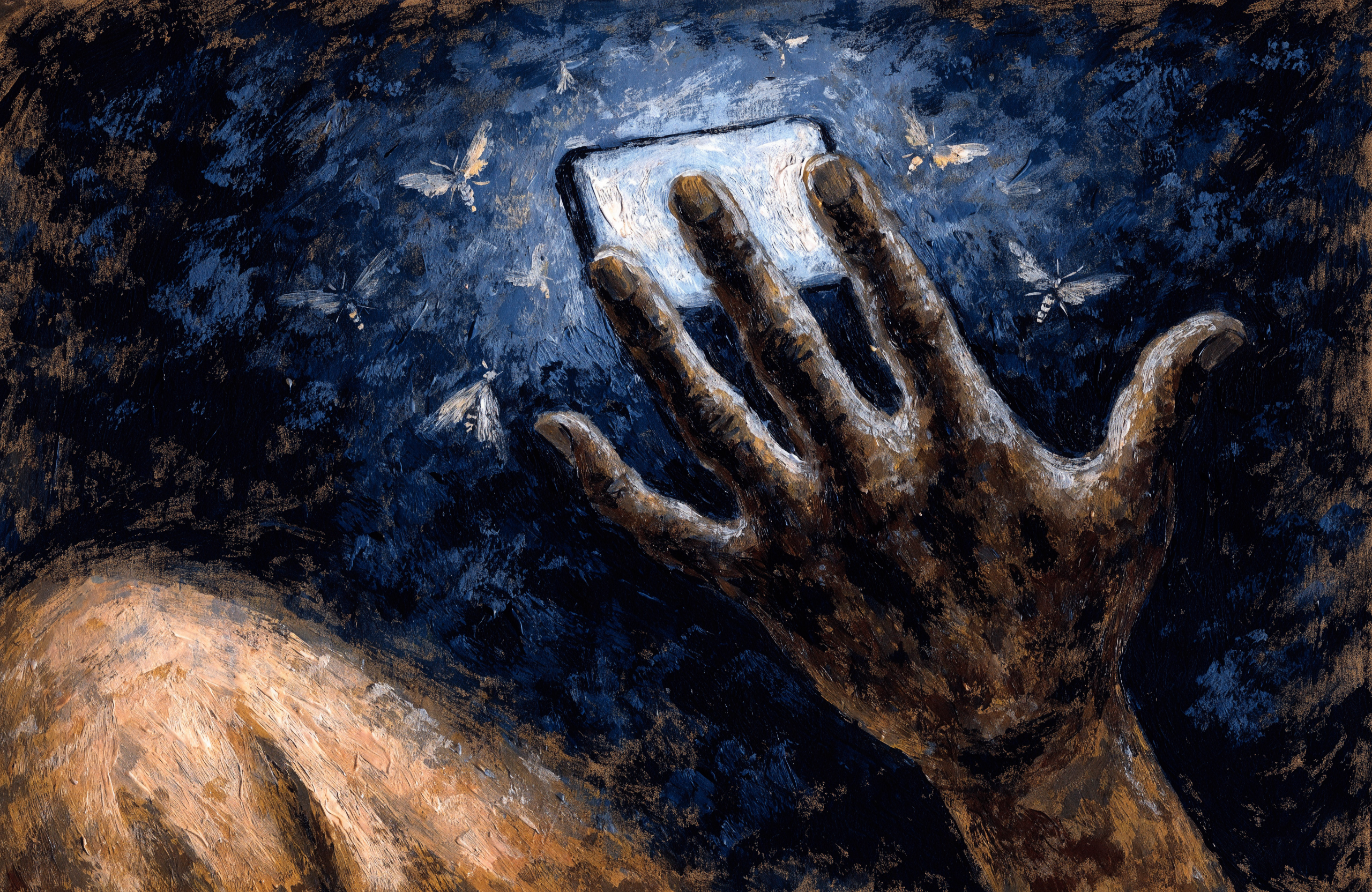
You think you are checking your phone. Look again. Your phone is checking you.
You pick it up to check one thing.
Twenty minutes later, you put it down. You cannot really say where the twenty minutes went. You feel a little tired, a little restless, and no better than before.
You did not choose that. It happened to you.
Here is the plain truth of this chapter: you do not use the phone. The phone uses you.
How the trap feels
You may already know these signs:
- Your hand reaches for the phone before your mind wakes up.
- You check it for no reason — in the lift, at a red light, mid-conversation.
- You sit down to do one hour of deep work and touch the phone nine times.
- You feel more tired after an hour of scrolling than after an hour of work.
- You promise "five minutes." It is never five minutes.
Now here is what you win back when you break this one habit:
- One to three hours of your day, returned to you.
- Deep focus — the kind that finishes hard work fast.
- Calmer nerves and better sleep.
- Full attention for the people in front of you.
One habit. That much reward. Let us see why it is so hard — and then, how the old masters solved it.
Why it is so sticky (it is not weak will)
It is not that your will is weak. It is that the trap is well made.
Your phone is a slot machine in your pocket. Think about how a slot machine works:
- You pull the lever. Maybe you win. Maybe not.
- That word — maybe — is the hook. An uncertain reward pulls harder than a sure one.
- Every swipe of your feed is a pull of that lever. A like, a message, a piece of news — maybe.
Your brain gives a small hit of a chemical called dopamine — not when you get the reward, but while you chase it. So you keep chasing. The chase is the trap.
And it is not an accident. Some of the cleverest people alive are paid to keep you pulling that lever. Scientists call this design "the hook," or the attention economy. Your attention is the product being sold.
There is one more cruel part. Each hit gives a little less joy than the last. Economists call it the law of diminishing returns. You scroll more and more, and feel less and less.
The tradition saw this — five thousand years ago
The trap is new. The mechanism is old. It was mapped long before the phone existed.
The Bhagavad Gita describes the exact chain that steals your twenty minutes:
ध्यायतो विषयान्पुंसः सङ्गस्तेषूपजायते ।
सङ्गात्सञ्जायते कामः कामात्क्रोधोऽभिजायते ॥
dhyāyato viṣhayān puṁsaḥ saṅgas teṣhūpajāyate
saṅgāt sañjāyate kāmaḥ kāmāt krodho 'bhijāyate
"While thinking about the objects of the senses, a person grows attached to them. Attachment gives birth to desire, and from desire comes anger."
What it means: you did not decide to scroll for an hour. It began the moment you "just looked." Looking became liking. Liking became craving. That is the whole slot machine, named long ago.
The Gita also knew the pleasure was real — but small, and shrinking:
ये हि संस्पर्शजा भोगा दुःखयोनय एव ते ।
आद्यन्तवन्तः कौन्तेय न तेषु रमते बुधः ॥
ye hi sansparśha-jā bhogā duḥkha-yonaya eva te
ādyantavantaḥ kaunteya na teṣhu ramate budhaḥ
"The pleasures born of contact with the senses are, in truth, a source of pain. They have a beginning and an end, so the wise do not get lost in them."
What it means: the joy of the screen starts, then ends, then leaves you emptier. The old text and modern economics say the same thing — diminishing returns. "The wise do not get lost in them." That is the goal.
But notice what the Gita does not say. It does not say "throw the phone away." Running away in fear is not mastery. Mastery is this:
यदा संहरते चायं कूर्मोऽङ्गानीव सर्वशः ।
इन्द्रियाणीन्द्रियार्थेभ्यस्तस्य प्रज्ञा प्रतिष्ठिता ॥
yadā sanharate chāyaṁ kūrmo 'ṅgānīva sarvaśhaḥ
indriyāṇīndriyārthebhyas tasya prajñā pratiṣhṭhitā
"When a person can draw the senses back from their objects, as a tortoise draws its limbs into its shell, their wisdom stands firm."
What it means: the tortoise is not afraid of the world. It pulls its limbs in when it needs to, then walks on. You do not need to smash the phone. You need to become the one who can pull back — and pick it up again — at will. That is freedom.
Your practice: the Digital Upavasa
Upavasa (उपवास)
A short, chosen fast. Not starving — a small, willing pause that makes you the master again. Here, a fast from the screen.
You do not need more willpower. You need better design and a small daily fast. Here are five simple moves:
- Make the bedroom phone-free. No screen for the first hour after you wake, and the last hour before you sleep.
- Turn off notifications you did not choose. Let the phone stay silent unless you decide to check it.
- Keep one "tortoise hour" a day. Phone in another room, fully out of reach, while you work or sit with family.
- Take ten slow breaths before opening any app. Most urges pass inside that small gap.
- Once a week, a full screen-fast evening. No feeds at all. Just people, food, a book, a walk.
Do not try all five. Pick one and do it tomorrow. Feel the difference for a week. Then add the next.
When you slip
You will slip. Everyone does. That is not failure. Remember the tortoise — it pulls in, then walks on. When you catch yourself lost in the screen, do not scold yourself. Just pull back, gently, and walk on. Doing that a hundred times is the practice.
The screen is not your enemy. Not being able to put it down is. Fix that — and the screen becomes a tool again.
Tomorrow, we take back the part of your day the phone steals first and quietly: the morning. It is where a calm, strong life begins.
Pick it up when you choose. Put it down when you choose. That is freedom.