Roots & Meaning · The Everyday Why
Why Do We Light a Lamp?
The small flame you light at dusk is not decoration. It carries one of the oldest prayers of your civilisation — and a quiet daily discipline.
A child asks: does God need our little lamp to see? No. The lamp was never lit for God. It was lit for you.
Almost every Hindu home does it.
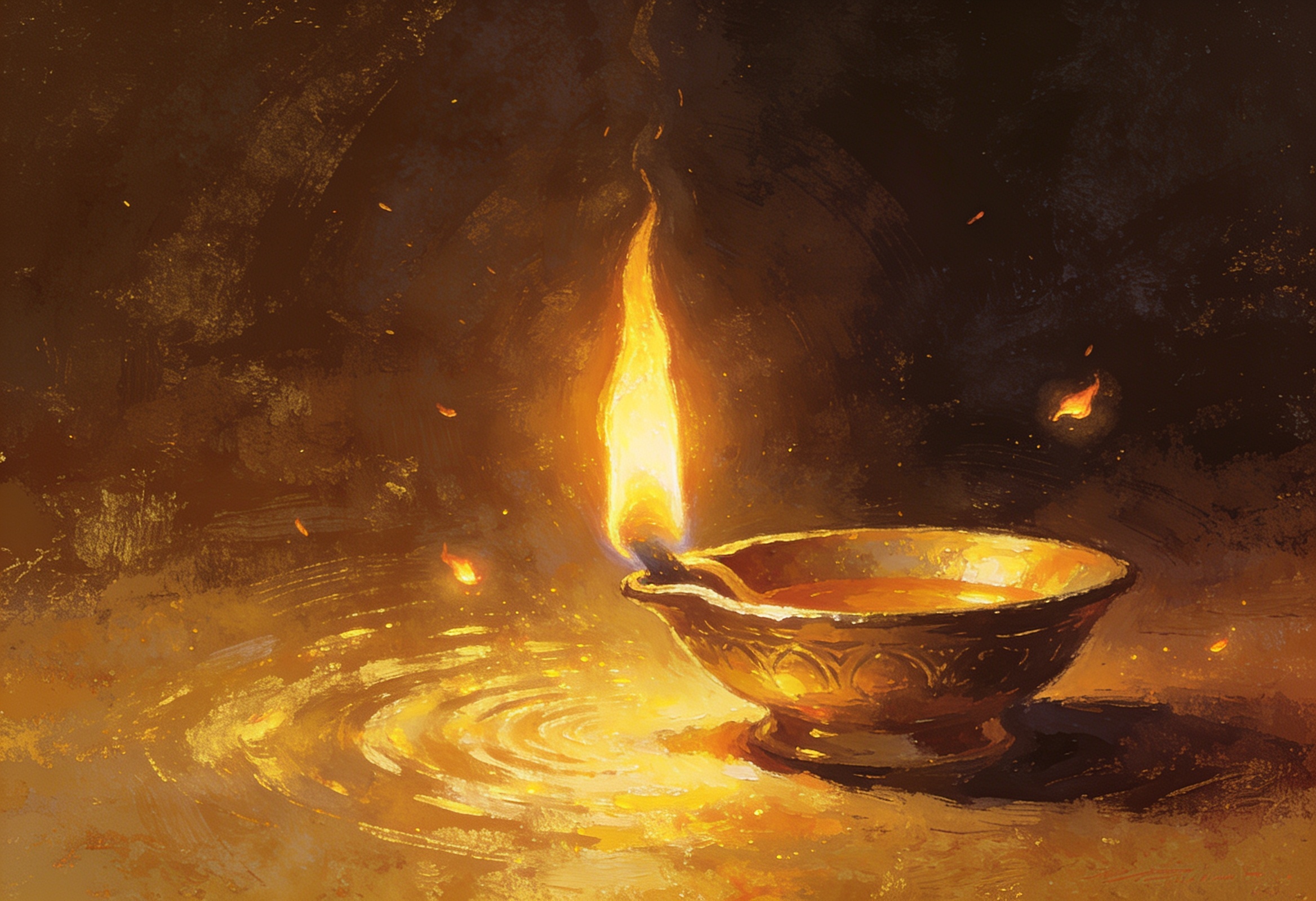
At dusk, someone lights a small lamp before the deities — a diya, a wick in oil or ghee, a soft gold flame in the gathering dark. We have seen it a thousand times.
And most of us, if a child asked "why?", would not have a real answer. "We just do." "It is our custom." That is the honest gap this piece fills — because there is a real answer, and it is beautiful.
What the lamp really means
In our tradition, light has always meant one thing above all: knowledge. And darkness means ignorance — not evil, just not-yet-seeing.
So when you light a lamp, you are acting out the oldest prayer in the Vedas:
असतो मा सद्गमय ।
तमसो मा ज्योतिर्गमय ।
मृत्योर्मा अमृतं गमय ॥
asato mā sad gamaya
tamaso mā jyotir gamaya
mṛtyor mā amṛtaṁ gamaya
"Lead me from the unreal to the real; from darkness to light; from death to immortality."
What it means: "From darkness to light" is not about the room. It is about the mind — from not-knowing to knowing, from confusion to clarity. Every evening, the little flame lets you say that prayer with your hands instead of your mouth.
Look closely at the flame, and it teaches four things at once:
- It always burns upward. However you tilt it, the flame reaches up — a picture of the mind lifting toward something higher.
- It gives itself away. The oil and the wick are slowly spent so that light can exist. That is the shape of every good life — something of the self is offered so that others receive light.
- A steady flame is a steady mind. A lamp in a still room barely trembles. The calm you want inside looks exactly like that.
- It asks for nothing. The flame simply shines. There is an old prayer that greets the lamp itself as the light of the Supreme — a reminder that the sacred is present, quietly, right in front of you.
The logic — why a flame, and what it does to you
There is plain, testable sense here too, not only symbolism:
- It began as the evening light. Long before electricity, the lamp was how you saw the deity at dusk. The practical became sacred, as good practices often do.
- It is the right light for the hour. A small warm flame is the opposite of a bright white screen. Warm, dim light in the evening does not keep the mind wired the way blue-white light does — it lets the body begin to wind down toward rest. Lighting a lamp at dusk is, quietly, good sleep sense.
- A single flame gathers a scattered mind. Resting your eyes softly on one small flame is a real focusing practice — the tradition calls it trāṭaka. A busy mind slows when it has one gentle point to hold.
- It marks the turn of the day. Lit at the junction of day and night, the flame is a signal to yourself: the working day is done; now turn inward, toward home and quiet. A simple, reliable cue that changes your state.
You will also hear bigger claims — that ghee lamps purify the air or release special energy. Treat those with care; they are not established, and the practice needs no such prop. The everyday good is real and enough, and none of it asks you to believe a word: the right light for the evening, a point of focus, a daily pause. The true power of the lamp is the meaning you light it with, and the habit of lighting it at all.
Why it still matters — and a small practice
We spend our evenings in harsh screen-light and endless noise. A small warm flame at dusk is the opposite of all that — a daily, physical act of turning from darkness toward light.
Try this, starting tonight:
- At sunset, light a single lamp or candle — at your shrine, or simply on a clean surface.
- Sit with it for one minute. Let your eyes rest gently on the flame; let the day's noise settle.
- Say the old line, silently: lead me from darkness to light.
- Then begin your evening — phone down, family up.
One minute. One flame. It costs almost nothing, and it quietly changes the shape of your evening.
The darkness the lamp fights is not in the room. It is the one we carry. That is why we light it again every single day.
We do not light the lamp to help God see. We light it to remember how to.