Roots & Meaning · The Everyday Why
Why Do We Remove Our Footwear?
At the temple gate, at the front door, we slip off our shoes without thinking. The reason turns out to be older, cleaner, and more sensible than "the gods prefer bare feet."
You wash your hands before you eat. You have never once thought to clean the one thing that walked across a public toilet floor — before you carry it into the room where your baby crawls.
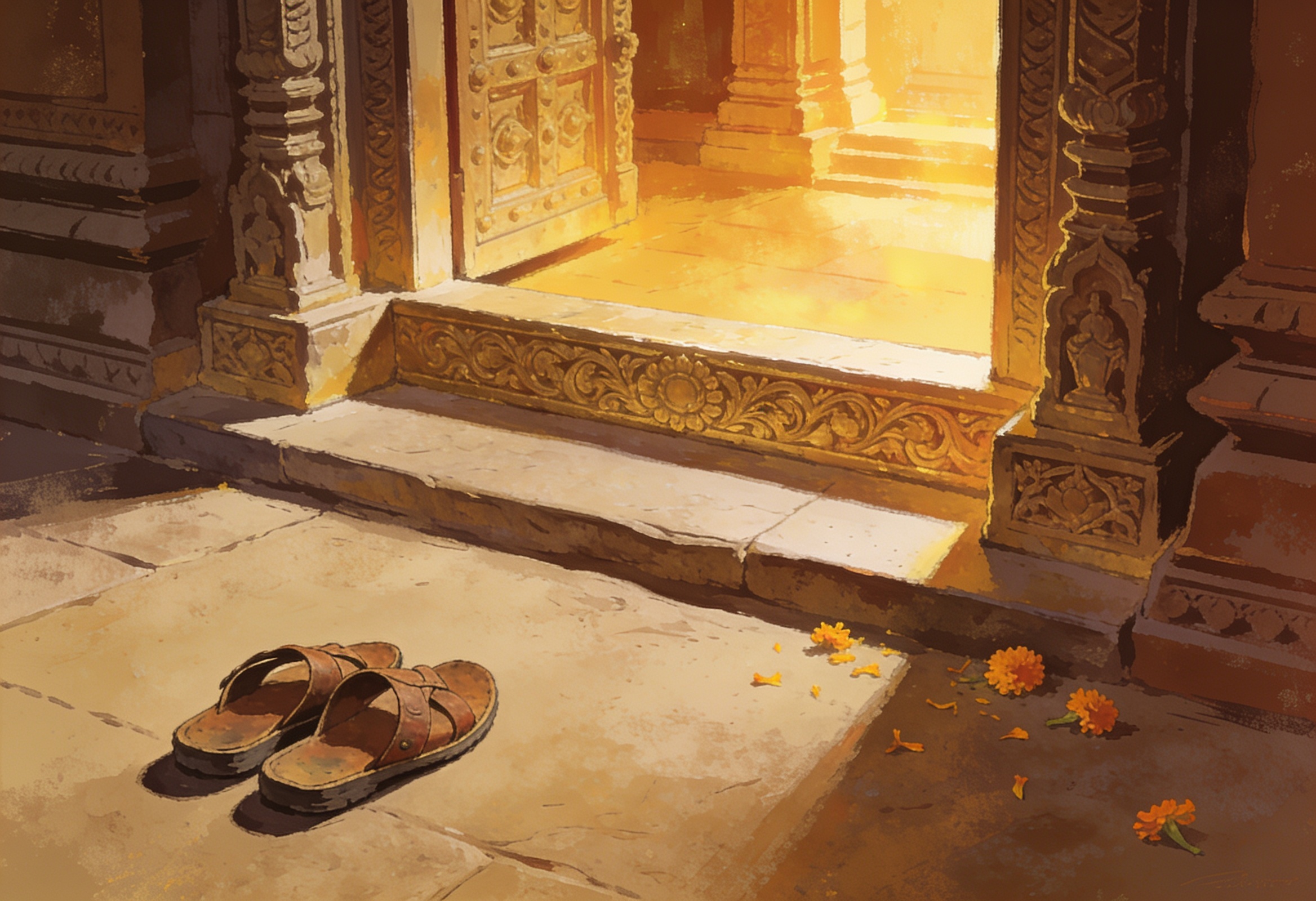
You reach the temple.
You stop at the steps, bend down, and slip off your shoes. At the front door of your own home — or a friend's — the same small act, without a second thought. Then you step in, barefoot, onto the clean floor.
Why? Most of us were never told. So here is the answer on four separate levels — the meaning, the body, the mind, and the many. Take whichever ones you trust. Even if you set the scripture aside, leaving your shoes at the door still does something real for you.
One · The meaning
Cleanliness comes first
There is no single verse that says "take off your shoes at the door." It is a long-standing custom, not a commandment. But it rests on an idea the tradition names clearly and puts first — śauca, cleanliness. In Patañjali's Yoga Sūtras, the personal disciplines of a steady life (the niyamas) are listed in order, and cleanliness is rung one:
शौचसंतोषतपःस्वाध्यायेश्वरप्रणिधानानि नियमाः ॥ २.३२ ॥
śaucasaṃtoṣatapaḥsvādhyāyeśvarapraṇidhānāni niyamāḥ || 2.32 ||
"Cleanliness, contentment, self-discipline, self-study, and surrender to the Divine — these are the niyamas, the personal observances."
What it means: of the five inner disciplines, śauca — cleanliness — is named first, before contentment, before effort, before study, before devotion. The tradition's quiet logic: you steady the outside before you can steady the inside. Leaving your shoes at the threshold is that whole idea shrunk to the smallest possible act — cleanliness made physical, right at the doorway.
Patañjali even notes what the habit earns: from cleanliness grows a natural pulling-back from clutter and craving (Yoga Sūtra 2.40)Yoga Sūtra 2.40 — śaucāt svāṅga-jugupsā parair-asaṃsargaḥ: from cleanliness comes a certain detachment from the body and a lessening of clinging to the physical. A subtler, inward fruit of the same first discipline., and attention turns inward. Cleanliness is not fussiness here. It is the doorway to a quieter mind.
Around that core idea sit three more, all of them plain:
- The threshold is a boundary. Shoes at the door draw a physical line between "the road" and "the refuge." You leave the outside world — its dust, its hurry, its transactions — at the edge. The space beyond is marked as set apart. That is exactly what sacred means: set apart.
- It is a small bow. You lower yourself; you touch the ground with the barest, most vulnerable part of you before the deity, the elder, the home. Shoes are armour and status. Taking them off is taking off a little of the ego.
- It is care for a shared floor. In temples and Indian homes, people sit, eat, and prostrate on the floor. Keeping it clean underfoot is a courtesy to everyone who will touch it after you.
Two · The body
What is really on the sole of your shoe
Here is where the custom stops being sentimental and starts being, frankly, hard science. Shoe soles are among the dirtiest surfaces you own — and this is measured, not imagined:
- In a University of Arizona study led by microbiologist Charles Gerba, the outside of everyday shoes carried an average of about 421,000 bacteria. 96% of shoes had coliform bacteria and 27% had E. coli on the sole — the fingerprint of contact with public-restroom floors and outdoor animal waste. Bacteria transferred from shoe to a clean tile 90–99% of the time.
- A multi-country study led from the University of Houston (samples 2014–2017) found Clostridioides difficile — a serious gut pathogen — on about 45% of shoe soles, the highest of any surface tested. An earlier study found it on shoe bottoms more often than on toilet seats.
- A peer-reviewed systematic review — Rashid and colleagues, 2016, Journal of Applied Microbiology — gathered the evidence that shoe soles ferry MRSA, C. difficile, and drug-resistant bacteria into hospitals, homes, and food spaces.
- Roughly 30–40% of the contaminants inside a home are tracked in from outside on shoes, clothing, and pets. House dust is a documented route for lead and pesticides — and small children, who crawl and put their hands to their mouths, are the most exposed.
So the temple did not need a microscope to be right. It just put a shelf at the door, three thousand years early. The cleanest, truest way to say it: removing shoes cuts what you carry indoors — the faecal bacteria, the lead, the pesticides — off the floor your family lives on. For a home with a crawling baby, an unwell elder, or anyone who eats or sits on the floor, that is a real, evidence-backed benefit.
Now the other half, told straight. Some things you will hear about bare feet do not hold up, and it is better to name them than pretend:
- "Shoes carry negative energy or bad vibrations into sacred space." There is no way to measure this and no evidence for it. It is a symbolic belief, not a fact.
- "Footwear blocks cosmic energy from entering through the feet." A metaphysical claim with no known mechanism. Unproven.
- "Bare feet on the earth — 'grounding' or 'earthing' — heal disease." The evidence here is weak and contested. The studies are small, often not blinded, rest on how people say they feel, and several come from parties selling grounding products. There is no solid, repeated proof that it treats or cures illness. Enjoy the cool floor under your feet — but do not expect it to fix your body.
Strip those away and nothing is lost, because what remains is already strong: cleanliness, respect, and a floor kept safe for the people you love.
Three · The mind
The little bend that changes your gear
Slipping off your shoes is a small, physical "I have arrived." Psychologists call these transition rituals — deliberate boundary acts that help the mind change state. The bend, the pause, the bare feet: the body tells the mind, plainly, the mode has changed now — from commuter to worshipper, from the street to home.
- Bare soles pull you into the present. Cool stone under your feet is strong, grounding sensory input. It tugs you out of your head and into the room you are standing in — a genuine attentional effect that needs no "earth energy" claim to be true.
- Removing your armour softens you. Shoes are one of the day's small defences. Taking them off at the door quietly lowers the guarded, transactional stance we wear through public space.
Four · The many
A level, shared floor
When everyone is barefoot, the CEO and the cleaner stand the same way on the same clean floor. Shoe-removal is a quiet equaliser at the temple gate — and a small act of hospitality in a home, where you keep clean the floor that the next guest will sit on.
It is also not ours alone. Mosques, gurdwaras, many Buddhist temples, and homes across Japan and Korea do the very same thing. The impulse to leave the outside at the door is human, not sectarian. One family, many houses, the same shelf by the entrance.
So — what if you don't believe any of it?
Then keep the three plain things that need no scripture, all of them true. One: shoe soles are among the dirtiest surfaces you touch daily — measured in peer-reviewed studies — so leaving them at the door keeps faecal bacteria, lead, and pesticides off the floor your family lives on. Two: the small bend-and-slip-off is a proven transition ritual that tells a scattered mind "you have arrived." Three: it is a visible act of respect — for a home, a host, a shared space. No energy, no cosmos required. The custom pays you back even if you believe none of the rest.
A small practice: a shelf and a mat at your door
You do not need a temple for this one. You need a doorway and a week.
- Put a simple shelf and a mat at your own front door — and actually use them.
- For one week, take your shoes off at the threshold and step in barefoot or in house-only slippers.
- Notice two things: the floor stays cleaner with far less effort, and there is a small "I'm home now" click each time you cross the line.
That is the whole teaching of śauca — cleanliness first — running quietly in your own doorway.
Two caveats, so the practice never harms you. On hot temple stone or sand in the Indian summer, bare feet can burn — a real danger if you have diabetes or nerve damage and may not feel the heat or a small cut until it is too late. Walk on shaded or matted paths, go early or after sunset, and check your feet afterwards. And because shared floors can pass on foot fungus or warts, wash your feet after — the answer is a wash, not keeping your shoes on in a sacred space.
Every threshold asks the same quiet question: can you leave a little of the outside world outside? The shoes are only the part of the answer you can see.
The tradition did not ask you to worship with bare feet. It asked you to arrive clean — and then made it a habit you could keep without thinking.