Surā pānam · Start Here
The Fuller Life
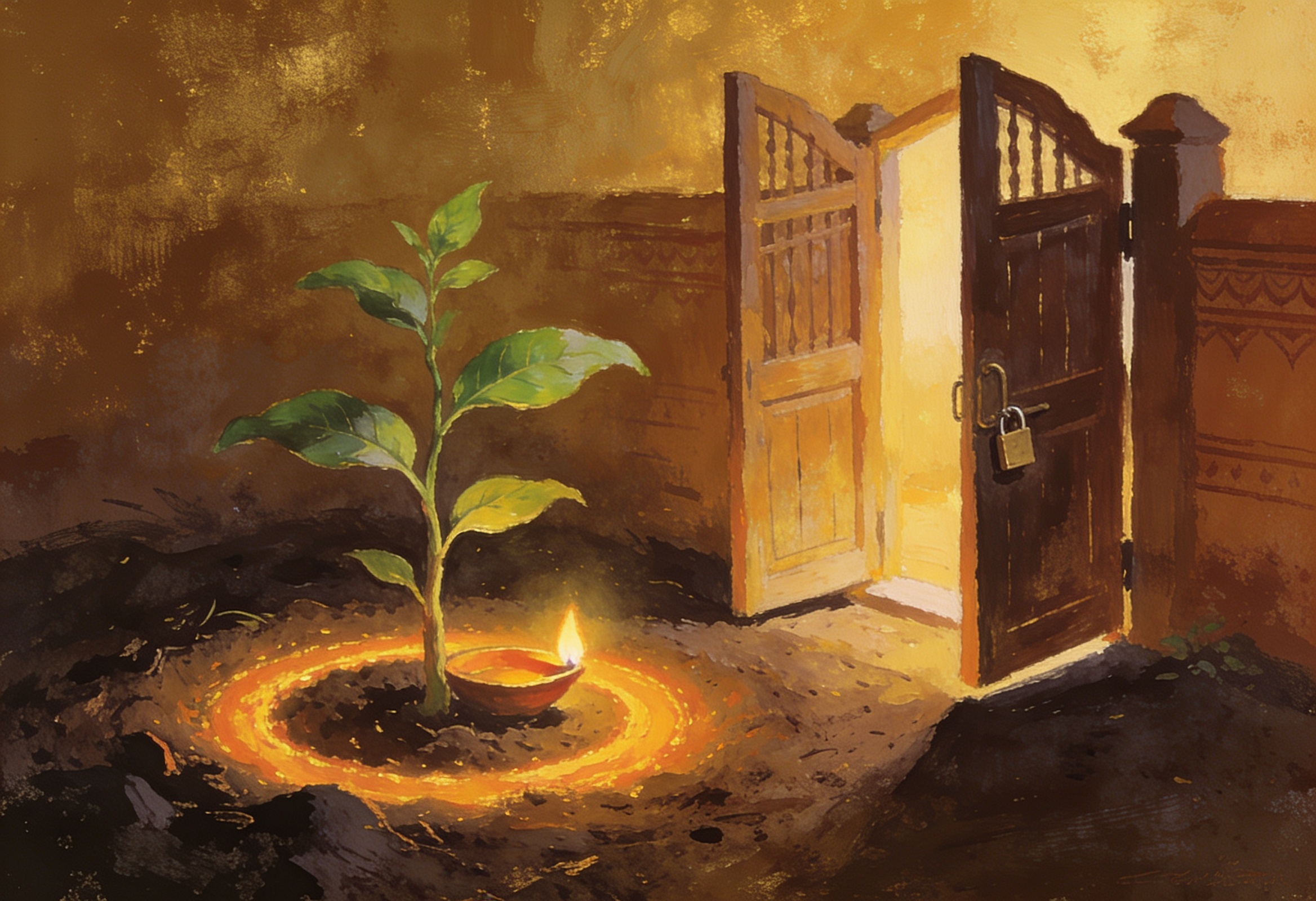
You cannot keep the world out with a wall — not from your children, not from yourself. You can only offer something so full and so true that nothing hollow can compete. That is the older way to root a life, and it is where this series begins.
You can forbid a child the whole world and still lose them. Or you can give them one thing the world cannot match — and never need to forbid at all.
Every worried parent, sooner or later, reaches for the same tool: the wall.
Keep the child away from that crowd. Off that app. Out of that party. And every anxious grown-up does the same to themselves — I'll just cut it out, block it, quit it. The wall feels like control. But walls make the thing outside look more interesting, and a young person raised behind one tends to climb it the moment it is unguarded. Fear is a poor foundation for a life. There is an older, steadier way — and this whole series is built on it.
First, what this is
Why Surā pānam exists
This series is for three people, who are often the same person at different ages: the curious child who asks "why do we do this?" and is told "just because"; the confused, tired adult who followed every rule of the modern race and still feels hollow; and the parent caught between them, wanting to hand down something real and not knowing how.
It exists to do one thing: to explain our own tradition — its festivals, its rituals, its practices — on its own terms and with reasons a sceptic can respect, so that a person can be rooted not by fear or blind habit but by understanding. We are not here to convert anyone, or to run anyone else's faith down. We are here to answer "why?" honestly. A few promises hold across every piece:
- No fear, no shaming. We root by attraction, never by dread. The tradition is offered as a gift, not a cage.
- No overselling. No "science has proven the Vedas," no miracle claims. Where something is genuinely established, we say so; where it is faith or experience, we say that too. Honesty is the whole method.
- No belief required to begin. Every practice is shown to work on plain human terms first. What you do with the deeper meaning is yours to decide.
- Depth over slogans. A person who understands their roots cannot be talked out of them. That understanding is the point.
And it starts here, with the single idea the rest of the series is really about.
The one idea
Every drift is a real need wearing a risky costume
Take a small, ordinary story. A young man starts going to the gym. Good — the body should be strong. But the crowd he falls in with lives for the mirror and the next conquest; they train, they network, they end up at the same bars, and a certain kind of evening becomes the whole point. A parent watching this panics: the gym did this. Stop the gym.
But the gym did nothing. The young man wants strength, confidence, to be admired, to belong — and not one of those is wrong. The danger was never the barbell. It was a strong body with no inner anchor, inside a circle that pulled only outward — so the good hunger, with nothing to hold it, drifted. That is the pattern under almost every worry you have, about your children or yourself: a legitimate need, reaching for the nearest thing that answers it, however hollow. So the cure is never to attack the need, and rarely even the costume. It is to meet the need more deeply — to out-nourish the drift until the hollow version simply loses its pull.
The oldest layer of the tradition named this exact fork in the road.
श्रेयश्च प्रेयश्च मनुष्यमेतस्तौ
संपरीत्य विविनक्ति धीरः ।
श्रेयो हि धीरोऽभिप्रेयसो वृणीते
प्रेयो मन्दो योगक्षेमाद्वृणीते ॥
śreyaśca preyaśca manuṣyam etas tau
saṁparītya vivinakti dhīraḥ |
śreyo hi dhīro'bhipreyaso vṛṇīte
preyo mando yogakṣemād vṛṇīte ||
"The good and the pleasant both come to a person. The steady one, examining them closely, tells them apart — and chooses the good over the pleasant. The dull one, for the sake of comfort and security, chooses the pleasant."
What it means: the Upaniṣad draws the line between śreyasSanskrit śreyas — the good, the truly beneficial; what serves you over a whole life., the good, and preyasSanskrit preyas — the pleasant, the immediately gratifying; what feels good right now., the merely pleasant. And notice the crucial word: the dhīra, the steady person, does not reject the pleasant. He tells the two apart — viveka, discernment — and then chooses the good over it. That is the whole art. Not walls, not fear. Discernment, plus an offer of something better. Teach a child to tell śreyas from preyas, give them enough of the genuinely good, and they will do the choosing themselves for the rest of their lives.
How it is actually done
Four quiet rules
- Attraction over fear. A life rooted in fear breaks free the moment it can; a life rooted in meaning stays. Sell the joy of the good, not the dread of the bad.
- Add, don't forbid. Rarely "instead of." Almost always "…and here is the part they are missing."
- Example over lecture. A child copies what you do, not what you say. Let them see you choose the good on an ordinary Tuesday.
- Never oversell. A sharp young mind smells exaggeration and throws out the whole message with it. The plain truth is strong enough.
The same key, many doors
The pattern, worked seven ways
Each of these is a common worry. Read each the same way: the need is always legitimate; the drift is what happens when nothing fuller is on offer; the fuller thing meets the very same need, more deeply.
1 · The gym and the physique
- The real need: strength, confidence, to be attractive, to belong. All good.
- Where it drifts: a strong body with no inner anchor, in a circle that pulls only outward. The appetite drifts because nothing holds it.
- The fuller thing: keep lifting and add sūrya-namaskāra, yoga, prāṇāyāma, dhyāna — the body-breath-mind wholeness the mirror never gives. Frame it as tapas (disciplined effort with an inner aim): the body kept strong for something. Weights build muscle and bone; breath and stillness build a calm nervous system, focus and self-knowledge — different gifts, so do both.
- Your move: train or do yoga with them; speak of a strength that isn't only skin-deep.
2 · The screen — scroll and games
- The real need: stimulation, mastery, escape, connection.
- Where it drifts: the gadget trap — dopamine on tap, attention shredded, real mastery and real friends crowded out.
- The fuller thing: one-pointed attention as a trainable skill — japa (repeating a name or phrase), a real craft, an instrument, a sport; seva (service) that gives the mastery-and-belonging hit for real. Frame screen fasts as strength, not punishment.
- Your move: protect one phone-free hour the whole family keeps — together.
3 · The party, the pub, the substances
- The real need: belonging, release, a rite of passage, the pull toward heightened, shared states.
- Where it drifts: borrowed belonging and a chemical release that costs more than it gives.
- The fuller thing: the tradition overflows with legitimate collective joy — bhajan and kīrtan (sung devotion), garbā and processions, festival nights, community feasts. Real belonging, real release, no morning after. Pair it with plain, non-shaming talk about substances — facts beat fear.
- Your move: make your home and community the fun place to be; don't cede joy to the pub.
4 · Dating and hookup culture
- The real need: love, intimacy, desire, to feel wanted and worthy. Legitimate — kāma (love, desire) is one of life's four proper aims.
- Where it drifts: intimacy as consumption — worth measured in conquests, connection that never holds.
- The fuller thing: kāma within dharma — self-respect, respect for the other, desire aimed at depth and commitment. The tradition's view of love is rich and warm, not prudish; teach that, not shame.
- Your move: talk about it openly and without disgust; model a marriage worth wanting.
5 · The rat-race and status anxiety
- The real need: worth, security, an identity built through achievement.
- Where it drifts: the toll-road life — endless comparison, burnout, a self that is only a résumé.
- The fuller thing: svadharma (your own road, not the neighbour's), niṣkāma karma (full effort, a loose grip on the fruit), santoṣa (the strength of "enough"). Ambition kept; anxiety loosened.
- Your move: praise effort and character, not only marks and pay-packets.
6 · "Who am I? Where do I belong?"
- The real need: identity and roots — the deepest hunger of all.
- Where it drifts: a young person ashamed of, or ignorant of, their own story is the easiest of all to uproot — which is exactly what the polemics against the tradition exploit.
- The fuller thing: give them the story, gloriously and truthfully — the festivals with their why, the language, the practices they can be proud of because they finally understand them. Rootedness is knowledge, not slogans. (This is what the rest of Surā pānam is for.)
- Your move: answer "why do we do this?" with depth, every single time. Never "just because."
7 · Meaninglessness, anxiety, the drift toward nothing
- The real need: meaning, steadiness, a reason to get up.
- Where it drifts: a bright, questioning mind with no framework drifts toward whatever offers the loudest certainty.
- The fuller thing: the philosophy itself — the fearlessness of Advaita (the non-dual vision), karma understood as agency rather than fate, dhyāna (meditation) for a steady mind. Meaning is the strongest anchor there is.
- Your move: let them question everything. A tradition that welcomes hard questions is one a thinking child can keep.
One guardrail
This is not a life of "no"
It matters that the tradition is not against the body, not against pleasure, not against success. It honours four aims at once — dharma (right living), artha (prosperity), kāma (love, desire, beauty), and mokṣa (freedom). The goal is never to starve a healthy appetite. It is to pursue it within dharma, so that it fills you instead of hollowing you out. A rooted life is not a smaller life. It is a much larger one — with a centre.
So — what if you don't believe any of it?
Then take none of the scripture and keep the method, because it stands on its own as simply the best way to raise a child or steady a self: don't fight the behaviour — meet the need underneath it, more deeply. Lead by attraction, not fear. Add, don't forbid. Show, don't lecture. Never oversell. A person — young or old — who has real strength, real belonging, real love, real purpose and a story they actually understand has no hollow place left for anything cheap to fill. You need no belief at all to see that this works. You only have to try it.
Where to go from here
A reading map
Surā pānam runs in three streams. Wander as you like — but here is a path:
- Practice & Purpose — how to live. The drifts above, one at a time, with the fuller thing worked out in full: reclaiming the morning, the breath that steadies you, the strength of "enough," finding your own purpose. If you feel derailed, start here. The next piece, The Gadget Trap, takes the first drift up close.
- Roots & Meaning — the why behind what we do. Every festival, every ritual, explained on its own terms and across several honest dimensions — why we light a lamp, ring the bell, greet with namaste, keep the festivals. If you are a parent answering a child, or a young person wanting to be proud of your own story, live here.
- Answering honestly — the hard questions. The sharp challenges people are made to feel ashamed of: idol worship, "so many gods," the sacred cow, and more — each met with depth and candour, never defensiveness. If a particular question nags at you, go straight to it.
Read slowly. One piece, tried in your own life, is worth ten admired and forgotten.
Have a question?
If something here puzzles you — a doubt, a "but what about…", a practice you cannot make sense of, or a hard question someone has thrown at you — send it to us. We read every one, and where it helps others we will answer it, with the same care and honesty as everything else here.
A small practice — one drift, one fuller thing
Do this for your child, or for yourself. It takes an evening.
- Name one drift you're worried about — the scroll, the crowd, the burnout, the restlessness.
- Ask, without judgement, what real need is underneath it — belonging? mastery? worth? release? Name the legitimate hunger.
- Choose one fuller thing that meets that same need — and offer it by doing it together this week, not by announcing it.
- Say nothing about what you're replacing. Just make the good thing present, and repeat it. Let the choosing become theirs.
That is the whole series in miniature. Everything that follows is simply more of the fuller thing, laid out one piece at a time, so that you and the ones you love have something too true and too full to ever be talked out of.
A river is not stopped by a wall thrown across it. But dig it a deeper channel, and it will follow the deeper way home — gladly, and on its own.
You do not root a life by walling out the world. You root it by giving it an inner world too full, and too true, to trade away.