Roots & Meaning · The Everyday Why
Why Do We Apply the Tilak?
A dot of red, or a cool line of sandal, on the forehead — worn over the exact spot the Gita tells you to rest your attention.
Of all the places to make a mark, why there? Because that small point between your eyebrows is where a scattered mind is meant to come home.
The puja ends, and a thumb presses a dot of kumkum to your forehead.
A bindi, a smear of sandal, three lines of ash, an upright red mark — the forms differ, but the place is always the same: the centre of the brow.
Decoration? Superstition? Neither, once you see it. Here is the tilak on four levels — the meaning, the body, the mind, and the many.
One · The meaning
A mark over the meditation point
The tilak sits at the bhrūmadhya — the point between the eyebrows. In our tradition this is the ājñā, the "command centre": the seat of focus, insight, the inner eye. To mark it is to honour it, and to remind yourself where the mind is meant to gather.
And this is not a vague idea. The Gita points the meditator to that exact spot:
स्पर्शान्कृत्वा बहिर्बाह्यांश्चक्षुश्चैवान्तरे भ्रुवोः ।
प्राणापानौ समौ कृत्वा नासाभ्यन्तरचारिणौ ॥
sparśhān kṛtvā bahir bāhyāṁś chakṣhuś chaivāntare bhruvoḥ
prāṇāpānau samau kṛtvā nāsābhyantara-chāriṇau
"Shutting out external contacts, with the gaze fixed on the space between the eyebrows, and the incoming and outgoing breath made even within the nostrils…"
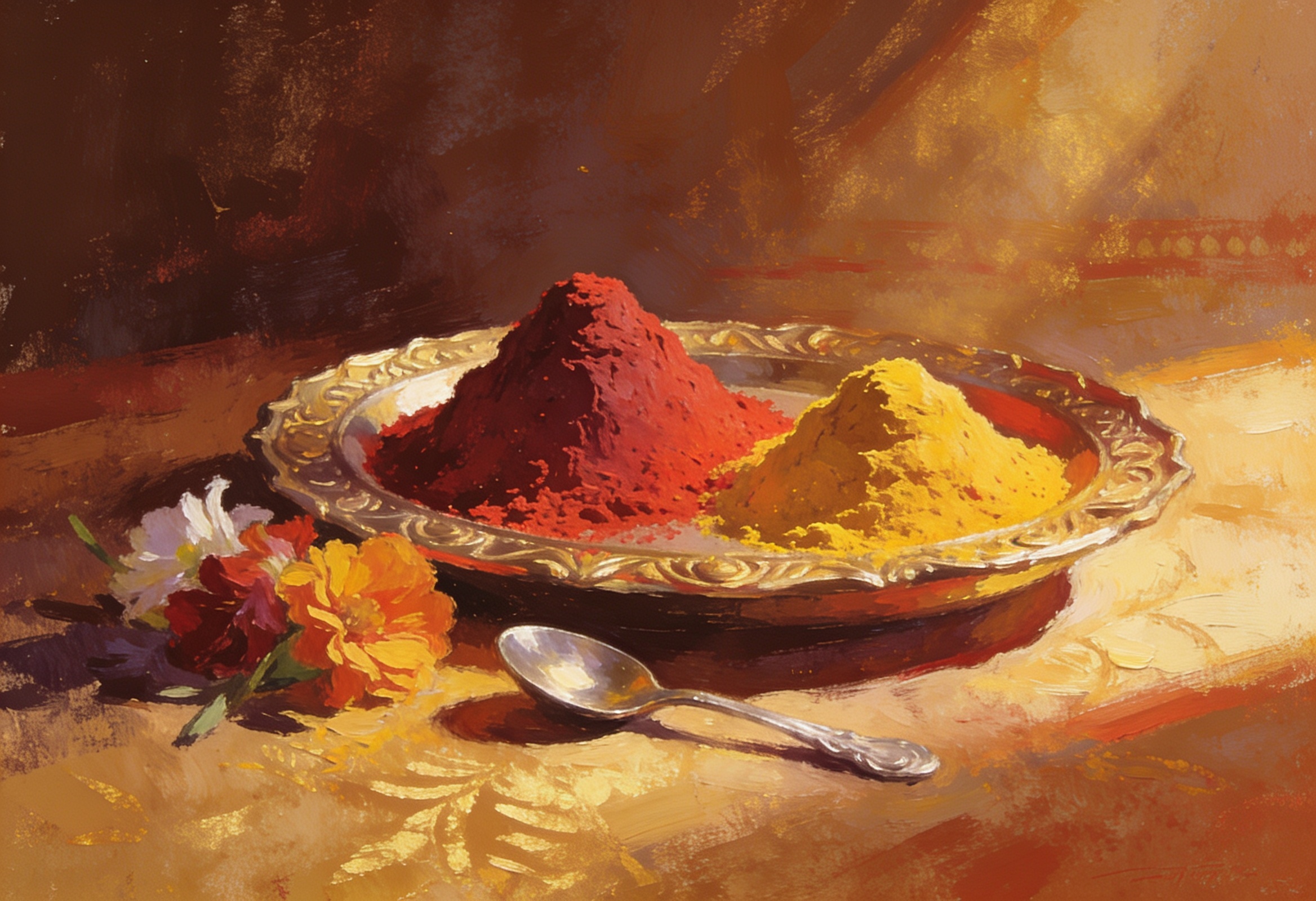
What it means: the meditator is told to steady the attention between the eyebrows — the very spot the tilak marks. So the tilak is a small, visible flag over the meditation point: a daily reminder that says "keep the mind here — steady, and high" — even as you walk out into your day. The materials add their own note: kumkum (red) for auspicious energy, chandan (sandal) for coolness and calm, vibhūti (ash) as a plain reminder that the body returns to ash, so live rightly. The shapes even show one's path — the upright Vaiṣṇava lines, the three horizontal Śaiva lines.
Two · The body
The modest science
- Sandal cools. A dab of chandan between the brows is genuinely cooling and soothing on the skin — pleasant, and calming to a hot, tired head.
- A gentle pressure point. The centre of the brow is a sensitive spot; a light touch or press there is relaxing — the same instinct that makes us rub exactly there when we are tense.
- Kumkum is traditionally turmeric-based, and turmeric has mild antiseptic qualities.
You will also hear that the tilak "activates the pineal gland" or "stops energy leaking from the third eye." Those specific claims are not established. Enjoy the real, modest good — the cooling, the calming touch, the daily reminder — and let the rest stay as poetry, not physiology.
Three · The mind
A reminder you carry all day
- A mark you can feel. Like a string tied on a finger, the tilak is a standing reminder of your intention — of who you are and how you mean to carry yourself. Every glance in a mirror re-centres you.
- Identity worn with dignity. To wear your tradition openly and quietly, without apology, is a small daily act of rootedness — especially in a world that quietly pressures you to blend in.
Four · The many
A sign of welcome and respect
The tilak is also how people of a shared path recognise and honour one another — and how a host welcomes a guest, pressing a mark of respect to the visitor's brow. It carries warmth, never exclusion: at a wedding or a festival, the tilak is offered to everyone who comes.
So — what if you don't believe any of it?
Then keep this. A cool dab of sandal is pleasant and calming. A light touch on that spot relaxes you. A visible mark is a proven way to hold an intention in mind all day. And wearing your own identity with quiet pride is good for anyone. Not one of those needs a verse.
A small practice
- In the morning, apply a small tilak — sandal or kumkum — slowly, with a light touch on the point between your brows.
- As you do, set one intention for the day: keep the mind steady, and high.
- Let it be a flag you carry — not for others to notice, but to remind yourself.
The mark is small. What it points to — a mind gathered at one steady point — is the whole of the practice.
We do not wear the tilak to be seen. We wear it so that we do not forget who we are trying to be.