Roots & Meaning · The Everyday Why
Why Idol Worship?
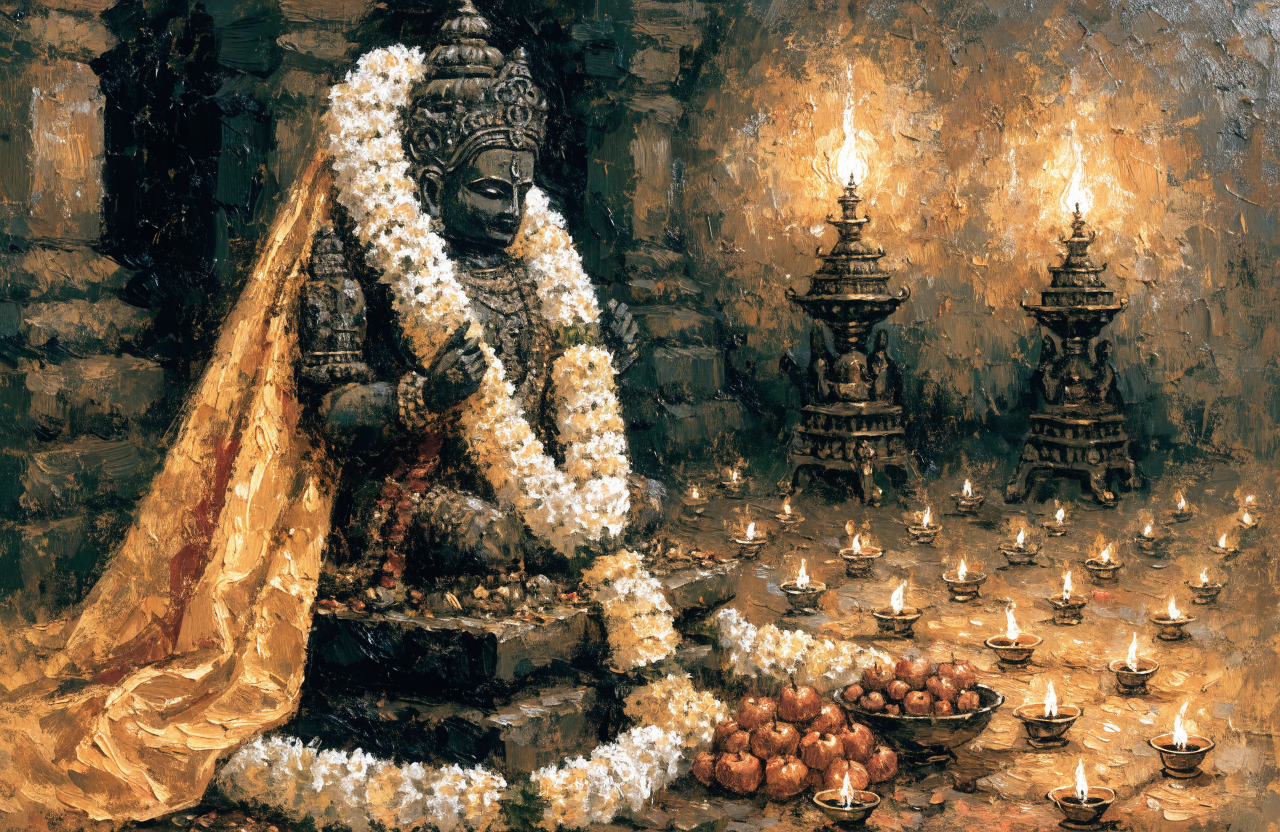
A stone shaped like a face. Flowers, a lamp, a whispered word — as if it could hear. The oldest question, asked kindly: do we really think God lives in the stone?
You keep a photograph of your mother on your desk. You glance at it, you smile, sometimes you say a word to it out loud. No one calls you confused. No one says you believe your mother is made of paper. You already know exactly what a mūrti is — and exactly what it is not.
Somewhere along the way, someone made you feel small about the little shrine at home.
The lamp, the fresh flowers, the tiny silver vessel of water, the form you bow to each morning. A caricature has followed the practice for centuries — an outsider's word, idolatry: bowing to dead matter, worshipping the stone as a superstitious end in itself.
That is a picture of a practice its describers never understood. The tradition's own word is not "idol." It is mūrti — form, embodiment — or arcā, the worship-image. And what the mūrti actually is turns out to be gentler, wiser, and more honest than either its mockers or its most literal-minded defenders tend to say.
So let us take it slowly, on four levels — the meaning, the science, the mind, and the many. And let us say the true thing out loud, early: the mūrti is a chosen support for a mind that needs a form to reach the formless — not the belief that God is trapped in stone.
One · The meaning
A door the mind can open
Sanātana Dharma holds two things at once, and does not flinch at holding both. The ultimate reality — Brahman — is nirguṇa: without form, beyond every attribute, name, and shape. And that same reality is saguṇa: approachable with form, name, and quality. The formless is real. The mind, tied to a body and its senses, struggles to hold the formless. So the tradition offers a form to begin with.
The mūrti belongs to that saguṇa door. And crucially, it is one door among several. Listen to the scripture itself — Kṛṣṇa instructing his friend Uddhava on how to worship:
अर्चायां स्थण्डिलेऽग्नौ वा सूर्ये वाप्सु हृदि द्विजः ।
द्रव्येण भक्तियुक्तोऽर्चेत् स्वगुरुं माममायया ॥ ९ ॥
arcāyāṃ sthaṇḍile'gnau vā sūrye vāpsu hṛdi dvijaḥ |
dravyeṇa bhaktiyukto'rcet svaguruṃ māmamāyayā || 9 ||
"In the sacred image, or on the consecrated ground, in fire, in the sun, in water, or within his own heart — with devotion and with offerings, let the devotee worship Me, his very own guide, who am free of all illusion."
What it means: the same one Reality can be reached through a form in stone, a fire, the sun, water — or purely within the heart. The image is a door the mind can open, not a box the Divine is shut inside. A jailer does not hand you five different keys to five different rooms. The tradition offers many supports and calls them all valid; form is simply the one many minds can hold most easily.
The tradition even lists the images it blesses — and the list quietly gives the game away. The Bhāgavata names eight kinds of sacred image: of stone, of wood, of metal, of clay, painted, of sand, made in the mind (manomayī), and of jewels. Two of those deserve a pause. One is an image built purely in the mind — no material at all. Another, the sand image (saikatī), is raised on a riverbank in the morning, worshipped, and washed away by night — built to be dissolved. If a picture drawn in the mind is a valid image, and an image of sand is meant to vanish, then the physical stone was never the point. The form is a support for attention and love; the material is secondary.
The critics said we worshipped the stone. But the very scripture that teaches image-worship lists eight kinds of sacred image — and one is made of nothing but the mind, and another of sand, raised at dawn and washed away by dusk. You do not build a god out of sand to keep. You build it to remember that the form was always a doorway, never the destination.
What about consecration — prāṇa-pratiṣṭhā, the rite that seems to "install life" in the image? Here it helps to be gentle and clear, because this is where the misunderstandings gather. In the rite, the deity is invited into the image with mantra; from then on the devotee treats the mūrti as a living presence — bathes it, dresses it, offers it food, puts it to rest at night. This is a devotional reality, and a beautiful one: it describes how the worshipper relates to the form, with the tenderness one gives a living, beloved guest. It was never a statement about the stone's chemistry — the life it speaks of lives in the relationship, not in the granite. Tellingly, in home worship the deity is invited and released each time — the tradition's own quiet way of saying the presence is welcomed in, never locked in.
Two · The science
The gift is not in the stone. It is in the attention.
You will hear the mūrti described as something that emits energy, that turns stone conscious, that radiates measurable "vibrations." Those are folk claims, and the mūrti simply does not need them. Its gift is quieter, more human, and — happily — the kind of thing science can actually see: a concrete object gives attention something to hold.
- Focused attention changes the brain. A 2025 review that gathered fifty-two brain-imaging studies found that sustained focus on a single target shifts the brain's rhythms in real, measurable ways. Cognitively, a mūrti is exactly this: a well-defined anchor for a wandering mind.
- Steady gazing at a fixed point (trāṭaka) has real, if modest, support. A 2014 trial with older adults found that a trāṭaka programme improved working memory, attention and executive function. A lamp-flame, or a mūrti, simply gives the gaze a steady home.
These are small, early studies — a promising beginning, not the last word, and we would not lean the whole practice on them. There is a further, gentle nuance the tradition holds easily: for some minds, an inner anchor — the breath, a mantra — settles things as well as any outward one. So we are not claiming an image is the best focus for everyone. Just that a concrete focus helps a wandering mind get started, and different hearts rest on different anchors. Which is exactly what the scripture said first.
Which is exactly what the eight-image list already told us, and what the anchor verse said first: image, or fire, or sun, or water, or the heart. Choose the door your mind can open.
Three · The mind
Why a mind reaches for a face
Ask a room full of people to send love and gratitude to "the infinite, formless ground of all being." Watch their minds slide off it like water on glass. Then place a small, kind face before them — and watch the whole room soften. The mind does not reject the divine. It reaches for a face.
- We think in images. As Vivekananda put it, we can no more think without a mental image than we can live without breathing. Love, thanks, an apology — all of these need somewhere to land. The mūrti is love's addressee.
- A concrete focus quiets a restless mind. The eye holds the form, the form holds the attention, and the freed heart can finally feel something. This is the same plain mechanism behind lamp-gazing and darśhan alike.
- Tactile devotion sticks. Bathing, dressing, feeding, decorating a mūrti turns an abstract belief into a daily, physical, caring relationship — the same reason a child learns better with something to hold. Actions build attachment far better than ideas alone.
- The training wheels need not come off — and there is no shame either way. Some move from the form to formless contemplation; many stay with a beloved form for life. Both are honoured. Ramakrishna moved freely between worshipping Kālī's form and seeing that form as the formless itself, appearing.
Four · The many
The abstract, made shareable — and a caricature retired
A whole family, a village, a festival crowd can gather around a common form and serve it together. Devotion becomes a shared act, not a private abstraction. The temple mūrti is a civic hearth — it organises music, art, food, generosity, belonging. The abstract cannot do that. A form can.
Now the caricature, corrected once and calmly, then set down. "Idolatry" meant worshipping dead matter as a superstitious end in itself. That is simply not what mūrti pūjā is — as everything above has shown. It was an outsider's word for a practice it misread. We note it, we correct it, and we carry no grievance out of the room.
And a caution from within the tradition, because rooted does not mean uncritical: the same scriptures that teach image-worship also warn against stopping at the image while ignoring the living beings around you. The mūrti is meant to open the heart toward all, not close it around a stone. A form that hardens you to your neighbour has missed its own purpose.
Which points to the only threat worth naming here — and it is never a person or a faith. The wrong is always a behaviour: mocking what another holds sacred; breaking images to coerce or humiliate; forcing a practice, or forcing its abandonment. A rooted person can worship through form and fully respect one who worships without form, or in another tradition entirely. Ekam sat — truth is one. Vasudhaiva kutumbakam — the world is one family. Rooted, and wide open.
So — what if you don't believe any of it?
Then drop every claim about gods and consecration, and something true and useful still remains: the human mind holds a form far more easily than an abstraction. You already know this. You keep a photo of someone you love; you look at it; you feel them near. You are not confused about paper and person — you are using a focal point for love. A mūrti is that, made deliberate and daily. The proven gift is attention and relationship, not magic — and that gift belongs to anyone who has ever missed a face.
A small practice
Two minutes with a single face.
- Choose any image that steadies you — a mūrti if you keep one, or the flame of a lamp, or even a photograph of someone you love and miss. Set it at eye level.
- For two slow minutes, let your eyes rest gently on it — not straining, not analysing, just resting.
- When the mind wanders — and it will — notice, and bring the gaze softly back to the form. That returning is the whole practice.
Whatever you believe about what the form is, you will feel what a concrete focus does — the noise drops, and something in you settles. That settling is the oldest reason we ever made an image to look at.
The same verse that says "worship Me in the image" also says: or in the fire, or the sun, or the water, or your own heart. Five keys to five different rooms. No jailer hands you those. The form is a door the tradition opens for you — never a cell it locks the Divine inside.
You were never asked to believe God is made of stone. You were offered a form the heart could love — and a quiet way back to the Formless that has no shape at all.