Roots & Meaning · The Everyday Why
Why Do We Offer Food to God First?
You bought it, carried it home, cooked it with your own hands. And still, before the first bite, an older instinct says: not yet. Set some aside. This meal was never only yours.
You paid for the rice. You lit the stove. You own every grain. So why does the oldest voice in the house ask you to give the first portion away — before you have tasted what is already yours?
The meal is ready — hot, fragrant, yours.
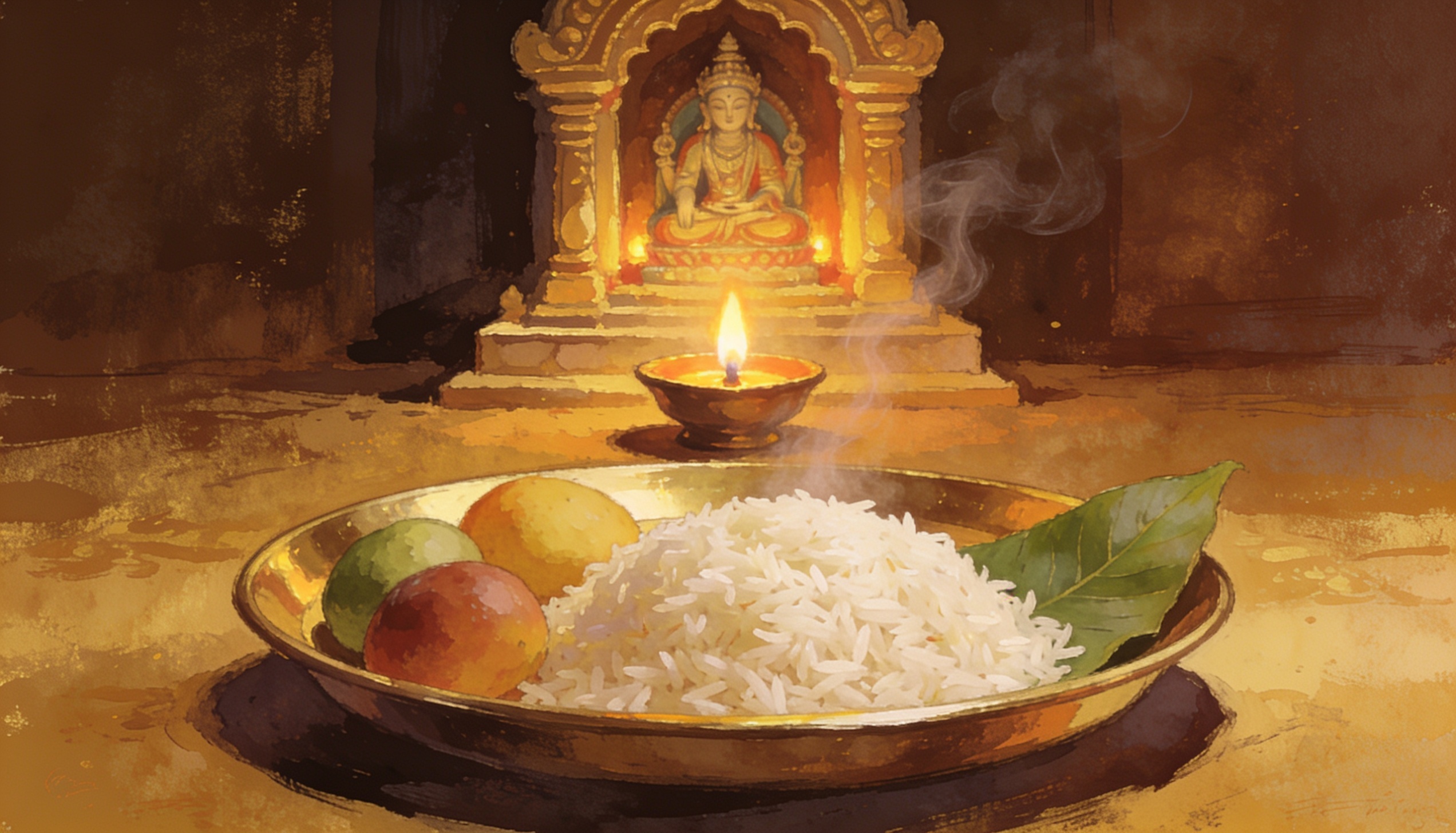
And before anyone eats, a small portion goes first to the divine: a spoonful set on a plate before the lamp, or the shrine, or simply held up for a moment. We call it naivedya — "that which is offered." What comes back is prasāda — the same food, now received as grace.
Why feed a God who does not eat? It can look like the emptiest of gestures. In fact it quietly rewires your whole relationship to the plate in front of you. Here it is on four levels — the meaning, the body, the mind, and the many.
One · The meaning
You receive the food — you do not own it
Think of everything that had to happen for this plate to exist. Sun and rain. Soil that took centuries to form. A seed you did not design. A farmer you will never meet. Hands that carried, cleaned, and cooked. You paid for the last few steps — but you made none of the first ones.
To offer the food first is to remember that chain. You lift the plate back toward its source before you take from it, saying with your hands: this came through me, not from me. The Upaniṣad puts it as plainly as it can be put:
अन्नं ब्रह्मेति व्यजानात् । अन्नाद्ध्येव खल्विमानि भूतानि जायन्ते ।
अन्नेन जातानि जीवन्ति । अन्नं प्रयन्त्यभिसंविशन्तीति ॥
annaṁ brahmeti vyajānāt · annād dhy eva khalv imāni bhūtāni jāyante
annena jātāni jīvanti · annaṁ prayanty abhisaṁviśantīti
"He knew Food to be Brahman. For from food alone are all these beings born; by food, once born, do they live; and into food they enter when they depart."
What it means: food is the sacred — the very thing every living body is born from, lives on, and returns to. To offer it first is simply to face that truth for a moment before you eat: this is not a dead commodity I happen to own; it is the holiest ordinary thing there is, and I am about to receive it.
And what you offer need not be costly — a leaf, a flower, a little water, a spoonful of rice. The value was never the point; the remembering is. The offering cannot bribe the divine and was never meant to. It is not for the God's hunger. It is for yours.
Two · The body
The pause before the first bite
You will often hear that the offering "charges" the food — that prasāda carries a divine vibration or positive energy that makes it more nourishing, even curative. Said plainly: there is no measurable evidence for this, and the food's chemistry does not change on the plate. It is worth being honest about that, because the real effect needs no such claim.
Here is the real thing. The offering forces a pause — a few unhurried seconds before you eat. And a pause before a meal is the doorway to eating with attention: you sit, you slow down, you actually look at the food. Slower, more attentive eating is consistently linked to noticing fullness sooner and overeating less. It is a modest, ordinary effect — and it is genuinely yours, every single day, for free. The ritual simply builds the pause in so you cannot skip it.
Three · The mind
From grabbing to receiving
Strip the offering to its bones and it is a thank-you said before you take. Nearly every culture on earth found some version of it — a grace, a blessing, a bow over the bowl. That is not coincidence. It works on the one who says it.
Gratitude, practised as a habit, is among the better-supported tools we have for steadier mood and contentment. And the meal is the perfect daily peg to hang it on — you eat several times a day, so you get several chances to shift, for a moment, from grabbing to receiving. The hungry, hurried self that snatches at the plate is not a happy self. The one who pauses to give thanks is quietly training a different way of meeting the whole day.
Four · The many
Food that binds people together
Watch what happens to the food after it is offered. It comes back as prasāda — and prasāda is shared. It is passed to everyone present, the same portion to the priest and the stranger, the elder and the child. For a moment the usual ladder of who-is-above-whom simply dissolves; everyone eats the same grace from the same hand.
In the home, the offering is why the family waits and eats together rather than each alone with a screen. Giving food — anna-dāna — has always been held as one of the highest, humblest gifts in this tradition, because it meets the plainest need there is. The habit of offering first quietly keeps the door open to feeding others, too: the guest, the hungry, the one at the gate. Food stops being fuel you consume in private and becomes a thread between people.
So — what if you don't believe any of it?
Then keep three things, and leave the rest. Pause before you eat — a breath is enough — and you will eat slower and better. Give thanks — name, even silently, the sun and hands that made the meal — and you practise the most reliable happiness habit we know. Share — set a portion aside for someone, or simply eat with others, not alone. No deity required. A person who pauses, thanks, and shares before every meal is already living well.
A small practice
- Before your next meal, stop for one slow breath before the first bite. Just one. Let the food wait.
- Silently name where it came from — the earth, the hands, the plain luck of having enough — and say thank you.
- If it feels right, set the first small portion aside: for the divine, for someone hungry, or for the birds. Then eat, slowly, as something received rather than grabbed.
The one who offers first never eats alone. Even in an empty room, he is at a full table — dining with everything and everyone that fed him.
Offer the first bite, and the whole meal changes — from something you take, into something you are given.