Roots & Meaning · The Everyday Why
Why Do We Do Aarti?
At the peak of the worship, the bell rings, the song rises, and a small flame is circled before the deity. Everyone leans in. Then the light is passed around — and each person cups it toward their own eyes.
You wave a small flame before the divine. But if the divine is the source of every light there is — what could your little lamp possibly show it? Perhaps the lamp was never for the deity's eyes. It was for yours.
Aarti is the crescendo of the pūjā.
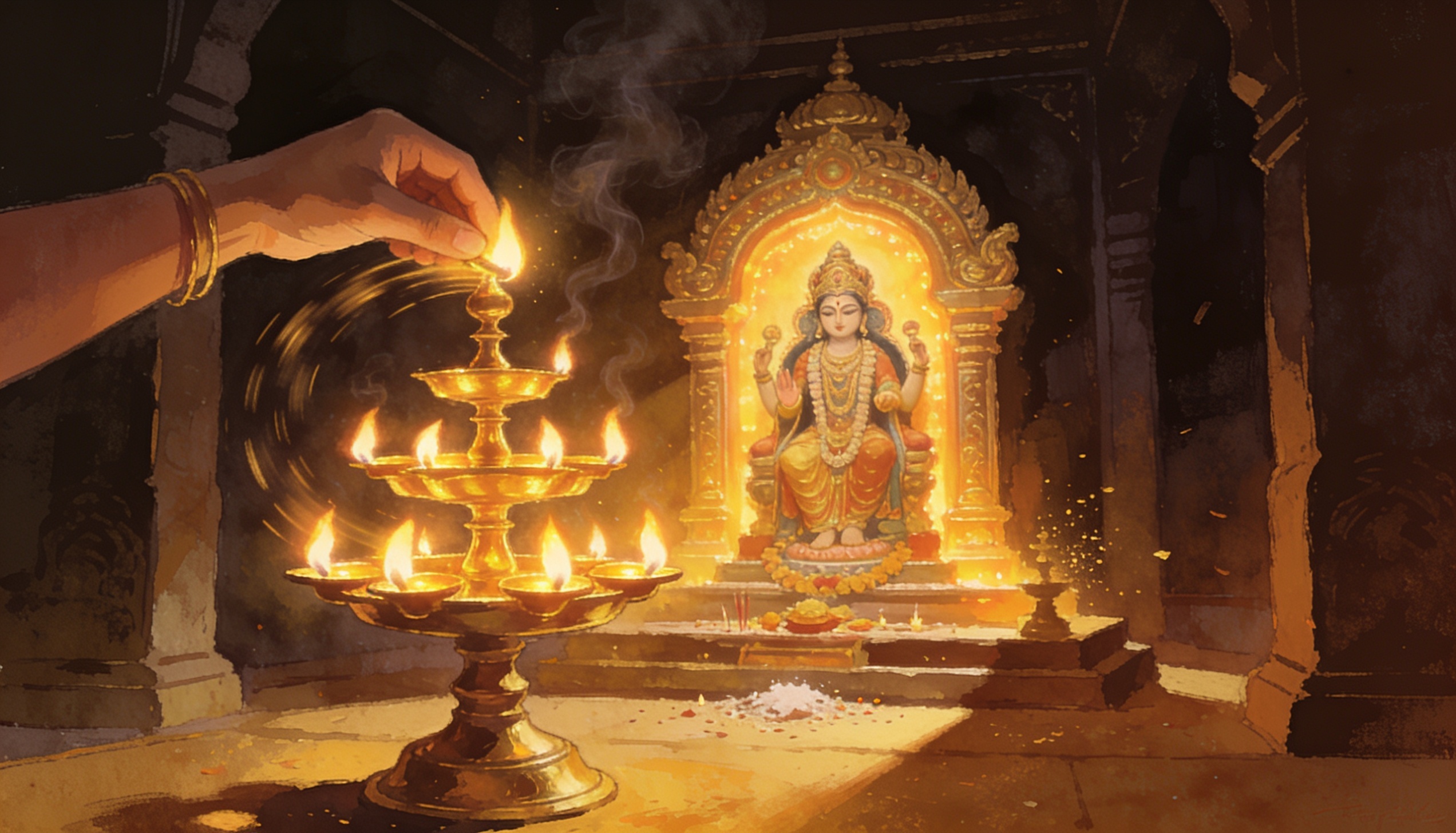
After the offerings, the priest lifts a lamp — often burning camphor — and circles it, slowly, before the deity, while the bell rings and everyone sings. Then the flame is carried to the gathering, and one by one people pass their palms over it and touch them to their eyes. We call this waving of light ārati.
Why show a light to a God? It can look like the emptiest theatre. In fact it is one of the most carefully designed moments in the whole tradition. Here it is on four levels — the meaning, the body, the mind, and the many.
One · The meaning
You lift a light so the divine can be seen
Begin with the plainest fact, the one we have forgotten. For most of history, the sanctum was a small, dark stone chamber with no windows and no electricity. The deity stood in near-blackness. Aarti was how you actually saw the form — the moving flame washed light across the face, the ornaments, the eyes, and the divine seemed to emerge, alive, out of the dark. The waving is not decoration. It was, first, simply light so there could be sight.
And the Upaniṣad names what that pool of light points to — the one light behind every light:
न तत्र सूर्यो भाति न चन्द्रतारकं नेमा विद्युतो भान्ति कुतोऽयमग्निः ।
तमेव भान्तमनुभाति सर्वं तस्य भासा सर्वमिदं विभाति ॥
na tatra sūryo bhāti na chandra-tārakaṁ nemā vidyuto bhānti kuto'yam agniḥ
tam eva bhāntam anubhāti sarvaṁ tasya bhāsā sarvam idaṁ vibhāti
"There the sun does not shine, nor the moon and stars, nor these lightnings — much less this fire. When He shines, everything shines after Him; by His light alone is all this lit."
What it means: the sun, the lamp, your eyes — all of them only borrow light from a deeper source. So the small aarti flame is not there to give the divine light; it is there to point at it. You wave a borrowed spark before the Light that lends brightness to everything — a tiny, honest confession: even this flame in my hand is not mine to keep.
And the flame turned outward has an inward twin — for the darkness that most needs lifting is not in the room:
तेषामेवानुकम्पार्थमहमज्ञानजं तम: ।
नाशयाम्यात्मभावस्थो ज्ञानदीपेन भास्वता ॥
teṣhām evānukampārtham aham ajñāna-jaṁ tamaḥ
nāśhayāmyātma-bhāva-stho jñāna-dīpena bhāsvatā
"Out of compassion for them, I, who dwell within their hearts, destroy the darkness born of ignorance, with the luminous lamp of knowledge."
What it means: the darkness that truly matters is not the dark of the sanctum but the dark inside — confusion, forgetting, the fog we mistake for ourselves. The lamp you wave outside is a rehearsal for the one that counts: a quiet lamp of understanding, lit within.
Two · The body
What the flame really does — and what it doesn't
You will often hear that passing your hands over the aarti flame and touching your eyes absorbs the deity's energy, or transfers a blessing charged into the fire. Said plainly: there is no measurable evidence of any energy passing from flame to hand to body. It is worth being clear about that, because what is actually happening is quietly lovely and needs no such claim.
- Real warmth. Your palms genuinely warm over the flame, and you carry that warmth to your eyes — a small, felt gesture of receiving. The feeling is real; it is just warmth, and warmth is enough.
- Real light. In a dark sanctum the flame does the honest work of letting you see — the original, practical reason the lamp is waved at all.
- Camphor that vanishes completely. Aarti often burns karpūra, camphor, and here is a genuine, quiet marvel: camphor sublimates — it burns away to nothing, leaving no ash, no residue at all. Nothing else on the tray behaves like that. The tradition read the fact as a teaching: let the small self burn clean and completely, and leave no trace of ego behind. The chemistry is real; the meaning is a gift laid on top of it, and named as such.
Three · The mind
A crescendo built for attention
Notice how many senses aarti seizes at once — the bell in your ears, the song in your throat, the camphor in the air, and the one bright, moving point of flame for your eyes. A wandering mind has nowhere left to wander. A small, moving light in a dim room is one of the most naturally gripping things a human eye can be given; steady gazing at a single flame is an old attention practice in its own right (trāṭaka). Aarti gathers a scattered, distracted person and, for two or three minutes, makes them completely present — no phone could compete with it.
And the closing gesture — cupping the warmth and drawing it to your eyes — is a small act of humility written into the body: I receive; I do not only take. You bow, in miniature, without a word.
Four · The many
One flame, one song, one room
Aarti is almost never done alone. Everyone sings the same lines, claps the same beat, and the same flame is carried to every pair of hands in the room — the elder and the child, the stranger and the neighbour, each receiving from the one light. Moving and singing together, in rhythm, is one of the oldest and best-studied ways humans build belonging and trust. For the length of the song, a room of separate people becomes, briefly, one.
So — what if you don't believe any of it?
Then keep this. A single, moving flame in a dim room is a near-perfect focus for a restless mind — a few minutes of genuine, undistracted presence you can rarely buy any other way. Singing and moving in rhythm with others reliably builds warmth and belonging. And cupping a little warmth toward your own eyes is a quiet, embodied way of practising humility and receiving. No deity required — the flame, the song, and the gesture do their work on anyone who shows up.
A small practice
- At the next aarti, don't just stand and watch. Sing, even softly. Let your eyes rest fully on the one moving flame and follow it — nowhere else.
- When the light comes to you, cup your palms over it, feel the real warmth, and carry it to your eyes as a gesture of receiving, not taking.
- At home, once, circle a small lamp before whatever you hold sacred for one slow breath — and let the flame stand for offering your own small light to something larger than you.
The flame you lift to your eyes shows you nothing new in the room. It shows you only that, somewhere in the day's noise, you had stopped looking. Aarti is the daily bell to look again.
The little flame is not there for the divine to see by. It is there to burn away, for one honest minute, the dark you had stopped noticing.