
Roots & Meaning · The Everyday Why
Why Do We Keep and Water a Tulsi Plant?
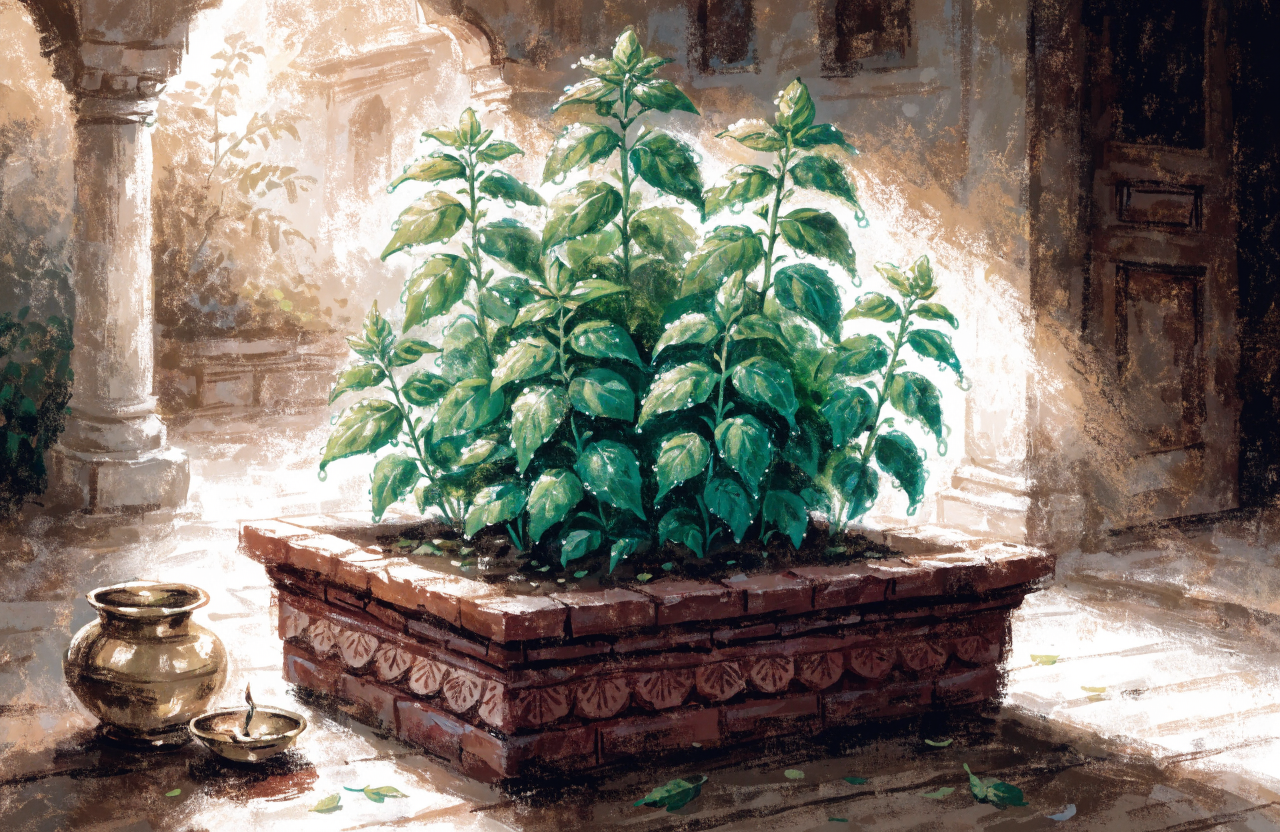
A small green plant sits on a raised pedestal at the doorway. Someone pours a little water on it every morning. Why this plant, this care, this daily pause?
You have probably been told the tulsi by your door "gives off oxygen all night." No plant does — in the dark, tulsi breathes in oxygen, exactly like you. The reason to keep her is older, and better, than a botany myth.
In countless Indian homes, one plant gets treated like a member of the family.
Not in the vegetable patch — on a raised, often ornate pedestal (the tulasī vṛndāvana), usually at the threshold or in the courtyard. It gets a daily pour of water, a lamp at dusk, sometimes a slow circle walked around it. No tomato plant is ever honoured this way.
So why the tulsi? The real answer runs on several tracks at once — a story the tradition tells, a herb the lab respects, a rhythm the mind loves, and a plant that quietly holds a home together. Let us take them one at a time, and keep the real cleanly apart from the claimed.
One · The meaning
The tradition says she is a person
Here is the first surprise. The tradition doesn't call the tulsi a herb. It tells you the plant is a woman — a devotee who was wronged, who grieved, and who was granted a deathless form. When you water her, you are not watering basil. You are greeting someone.
The story is told in more than one version. In the Śiva Purāṇa, she is Tulasī, the utterly faithful wife of the demon-king Śaṅkhacūḍa; in the Padma Purāṇa, she is Vṛndā, wife of Jalandhara. In both, her chastity is so complete that it makes her husband unconquerable in war. To let the gods prevail, Viṣṇu takes the husband's form and deceives her; her fidelity broken, the husband falls. Realising the deception, she curses Viṣṇu to become a stone — the śālagrāma. She is then consoled and blessed to leave her mortal body, take a divine form ever near Viṣṇu, and live on as the tulasī plant, foremost in all worship.
Treat this plainly for what it is: a story the tradition tells to explain the plant's sanctity — told in more than one version, differing on names and on who curses and who blesses. It is not history, and it is not science. Its worth is symbolic and devotional. Here is the moment the story turns her into the plant:
स्वर्गं मर्त्ये च पाताले तिष्ठ त्वं हरिसन्निधौ ।
भव त्वं तुलसीवृक्षो वरा पुष्पेषु सुन्दरी ॥ ४६ ॥
svargaṃ martye ca pātāle tiṣṭha tvaṃ harisannidhau |
bhava tvaṃ tulasī-vṛkṣo varā puṣpeṣu sundarī || 46 ||
"In heaven, on earth, and in the world below — abide near Hari. Become the Tulasī tree, O lovely one, most excellent among all that flowers."
What it means: the tradition's own story says the tulsi is a faithful woman granted a new, deathless form beside the divine. So tending her is tending a beloved presence — not watering a herb. That is why she gets a raised pot, a lamp, and a daily pour of water. It is also why the tulsi leaf "completes" an offering to Viṣṇu, why she is paired with the śālagrāma stone, and why Tulasī Vivāha — her ceremonial marriage to Viṣṇu each Kārtika — opens the wedding season.
You will also hear a lovely line recited beside the plant — "at her root, all holy waters; in her middle, all the gods; at her tip, all the Vedas" (yan-mūle sarva-tīrthāni…). It is a widely-loved traditional Tulasī prayer, and we quote it as exactly that — a devotional verse, not a scripture with a chapter and verse we could point you to. The same is true of the familiar vṛndāyai tulasī-devyai salutation: a traditional pūjā verse, cherished but not a citable text.
Two · The body
A genuinely useful herb — and a pile of myths
Strip away the metaphysics and there is still a real plant here worth respecting. "Tulsi" or holy basil is Ocimum tenuiflorum (also called Ocimum sanctum), an aromatic cousin of mint. Its leaves are rich in eugenol — the same warm compound that gives cloves their scent — along with ursolic and rosmarinic acids. Where the evidence is real, it is worth saying plainly:
- An anti-stress effect — in humans. A randomised, placebo-controlled trial of 100 stressed adults over 8 weeks found a standardised holy-basil extract improved perceived-stress and sleep measures versus placebo (Lopresti et al., Front Nutr 2022). Real, but a single extract, industry-linked, modest in size — an early signal, not a settled fact.
- Broad but early clinical promise. A systematic review of 24 human studies (1,111 participants) reported favourable results across blood-sugar, lipids, blood pressure, immunity and mood — while flagging that most of those studies were low in quality (Jamshidi & Cohen, eCAM 2017). Promising, not proven.
- Antimicrobial and insect-repellent action. A pharmacology review documents genuine adaptogenic and anti-anxiety effects in models, broad antimicrobial activity (a tulsi mouthwash held its own against standard rinses on oral bacteria in trials), and mosquito-repellent action from its eugenol (Cohen, J Ayurveda Integr Med 2014). Mostly in-vitro or small-trial — early evidence, not "cure."
That is an impressive, honest résumé for a doorstep plant. Now the folk claims that get attached to it — which are not true, and are worth naming clearly:
- "Tulsi releases oxygen 24 hours a day / at night" — false. Releasing oxygen is photosynthesis, and photosynthesis needs light. In the dark, every plant — tulsi included — does the reverse: it respires, taking in oxygen and giving off carbon dioxide, just as you do. No plant nets out oxygen in darkness.
- "It purifies the air of the whole house" — no. A single potted plant's effect on real room air is negligible. The famous "plants clean the air" studies were done in sealed chambers, not homes; you would need dozens of plants per room to matter. Planting tulsi in the open en masse — as in outdoor greening projects around monuments like the Taj Mahal — is a different thing entirely from one pot on a windowsill. Don't conflate them.
- "It kills the germs in a room" — no. Its oils are antimicrobial in a dish or a mouthwash. There is no evidence a living plant disinfects the air of a room.
- "Positive energy / removes negativity" — not a testable claim. This is belief, offered as belief. It is not established fact, and we won't dress it up as one.
A mouthful of tulsi in a lab fights bacteria as well as a branded mouthwash. A whole tulsi plant does not sterilise your living room. The tradition kept the plant for love; the science kept it for the leaf. Both are true — just don't swap them.
A word of care
A word of care before you brew it daily
Ordinary devotional and culinary contact with tulsi — a few leaves in worship, a leaf in your tea — is not a concern. The 24-trial review above found no serious adverse events. But one caveat genuinely matters:
- On blood thinners or facing surgery? Eugenol-rich plants can have mild blood-thinning activity. As a prudent precaution — not an established interaction — avoid high-dose tulsi supplements alongside anticoagulants or before surgery, and ask your doctor.
Three · The mind
The oldest use of the plant is the pause
Every morning, before anything else, someone in the house pours a little water on one plant. It changes nothing in the world and everything in the person. That is the actual technology here.
- A daily ritual anchor. Watering the tulsi each morning is a tiny, fixed, embodied routine — the kind of small repeatable act that steadies attention and marks the start of the day. The benefit is the rhythm and the care, not magic in the leaf.
- Tending a living thing lifts mood. There is a separate, genuine body of research on active gardening and horticultural therapy: caring for a plant lowers stress and gives a real sense of agency. A sceptic can accept this without a word of scripture.
- The story models a value. A moment beside the plant is a moment of contact with an idea the household wants to keep alive — fidelity honoured, grief transformed into something enduring.
Four · The many
A plant at the threshold holds a home together
The tulsi at the doorway is a shared family focal point. Children learn to water it; elders light the evening lamp beside it; the household gathers around it for Tulasī Vivāha and the observances of Kārtika. It is social glue disguised as gardening.
And a green, pollinator-friendly, mosquito-discouraging herb by the door is a quietly sensible thing for a community to have kept for centuries — the eugenol scent genuinely puts off some insects, and a culinary and medicinal herb within arm's reach of the kitchen is simply useful. Keep it proportionate: useful, not a mosquito shield.
So — what if you don't believe any of it?
Then keep this. A tended plant by your door gives you a 30-second daily ritual that steadies the mind, a genuinely anti-stress and antimicrobial herb within reach, and a focal point the whole family shares. None of that needs the story to be literally true. A family that treats none of the metaphysics as fact still ends up with a calming morning rhythm, a herb in the kitchen, and something living to care for together. That is the "so what" that asks for no belief at all.
A small practice
Try the morning pour — about sixty seconds.
- Before you touch your phone, take a small cup or lota of water to your tulsi — or to any plant by a window, if you don't keep one yet.
- Pour it slowly at the root. For those ten seconds, notice one thing — the smell of the leaves, the light, your own breath.
- Name one thing you intend to do steadily today. That's it. You have borrowed the oldest use of the plant: a fixed, caring pause that starts the day rooted.
(If you keep tulsi and use it in tea, ordinary amounts are fine. Only high-dose tulsi supplements are worth a doctor's nod — everyday leaves in food and worship are not.)
The tradition doesn't call it a herb. It says the plant is a devotee who was granted a deathless form. You are not watering basil. You are greeting someone.
One plant, one pour, one quiet minute. It changes nothing in the world and everything in the person who kneels to water it.