The Curtain-Raiser
The Ladder Down, and the Older Way Up
What is quietly going wrong in a successful modern life. Why it will matter even more in the age of AI. And the oldest, most tested way to a life with no regrets and no hidden costs.
You did everything right.
You passed the exams your family prayed over. You earned the title, the salary, the flat with a good view. By every measure you were given at twenty-two, you have won.
So why, late on a Tuesday night, are you awake in the blue light of your phone — heart beating a little fast, tomorrow already heavy — and you cannot say what is wrong? On paper, nothing is.
Maybe it is not only the phone. Maybe it is some of these:
- You wake up tired. You reach for the screen before you reach for the day. The first hour is gone before you choose.
- You earn more than you once dreamed of — and feel less peace than when you had less.
- You are short with the people you love most, and patient with people who matter least.
- A low worry hums in the background. The years seem to blur past.
If even two of these felt true, stay with me.
You are not broken. You are not alone. This is not your fault. It is the result of a system you were handed — and never chose.
Why this is happening to you
Two generations ago, we made a quiet swap.
We gave up a way of living that was shaped over thousands of years. We took on a new one, built in a few decades — and sold to us for profit.
The new system has simple rules:
- Measure your worth by your salary and your followers.
- Treat rest as lazy. Treat stillness as waste.
- Give your attention to apps built to break it.
- Copy your idea of success from a screen. Copy your idea of "enough" from an advert — one made so you never feel enough.
- Move fast. Want more. Never arrive.
This system is built for someone else's profit, not your peace. And it works. You are busy, connected, entertained — and quietly empty.
The fault was never you. It was the manual.
Notice the trade you never agreed to. The richer you grew, the worse you slept. Same person. Same years. One hidden bill.
The bill you did not know you signed
Every borrowed life is a toll road. The price is real. It is just collected quietly, and late.
You can hit every target and still reach the end having paid with things no salary slip shows:
- your health
- your marriage
- your attention
- your conscience
- your simple joy
That is the true cost of the modern manual. Not that you fail. That you succeed — and are billed for it in your sleep, your body, and your child's memory of a parent who was always half-there.
So let us name where we are going. You cannot reach a place you have not named.
A regret-free, toll-free life
Toll-free — you travel without paying those hidden costs. The journey does not quietly rob the parts of you that matter most.
Regret-free — you reach the end of the road, and you would choose the same road again.
Ask a dying person what they regret. It is never the deal they lost.
What we really regret — the proof is clear
This is not a nice saying. It is data.
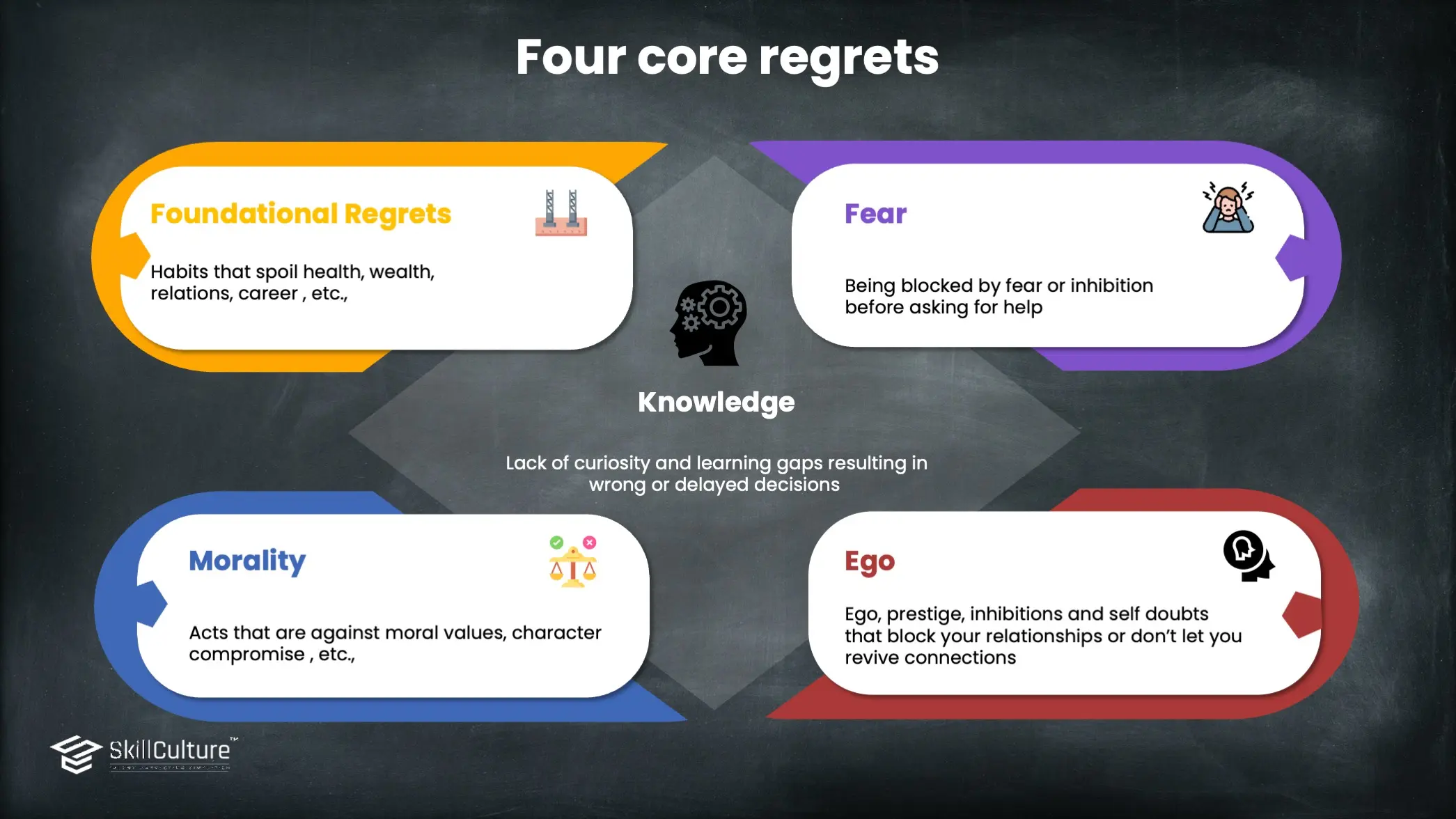
Daniel Pink asked more than 16,000 people in 105 countries what they regret. Almost every answer fell into four groups:
- Foundation — small daily choices that slowly ruin health, money, or skill.
- Boldness — the chance not taken, the words not said, stopped by fear.
- Moral — the moment we knew the right thing, and did the other.
- Connection — a bond we let slip away, "slowly and quietly."
Bronnie Ware, a nurse for the dying, heard the same thing. Almost no one wishes they had worked more. They wish they had lived true, felt more, and stayed close to the people they loved. (the research)
Read the list again. Notice what is missing.
None of these regrets is about the scoreboard — the title, the salary, the followers. Every one is about the inner life we kept leaving for "later."
And under all four hides a fifth: the curiosity we never used — the questions we never asked, until the choice was made for us. Put plainly: boldness is usually lost to fear, connection is often lost to ego, and beneath them sits a gap in knowledge.
So a regret-free, toll-free life is not a life with no pain. It is a life built so that the things you would most regret losing are the things you actually protect. This can be trained. That is what this series does.
The two turns it asks of you
The way out is not another app or another hustle. It is two simple turns of the head.
Turn one: look inward. Every modern fix points outward — buy this, achieve that, become someone new. The oldest wisdom points the other way. Calm, focus, contentment, steady nerves — these are not things you buy. They are skills of your own mind. You already own the tools. You were just never taught to use them.
Turn two: look homeward. Before you buy one more foreign wellness trend, sit with one fact. You are the heir of the oldest living civilisation on earth. For more than ten thousand years it has run one long test: how does a person truly live well? Not in theory — in real life, across millions of people, kept only if it worked.
What has lasted ten thousand years was not kept by accident. It was kept because it works.
We were taught to say, "that's old, it does not fit modern life." Turn that thought around.
In every other field, we trust what lasts — the tools and proofs that outlived the rest. A civilisation still alive, still practising, after ten thousand years did not survive by being wrong about how to live.
These practices are not superstition. They are the results of the longest study of human happiness ever done — and you were born holding the notes. This is your invitation to finally read them. Not out of pride, but out of plain self-interest. They work. And they are yours.

When the machine can do everything you were praised for — what are you worth?
Your real edge in the age of AI
For twenty years we were told the future belongs to skills — coding, analysis, writing, speed.
Then, in about eighteen months, a machine learned to do most of them — for almost nothing. The skills are becoming cheap in front of our eyes.
But there is one thing the machine cannot copy. It is the very thing the modern manual told you to ignore: a calm, wise, present human being.
- Good judgement when the data runs out.
- Honesty when doing right has a cost.
- Attention you actually control.
- The calm to decide well while others panic.
- The sense to spot a trick — human or machine — before it lands.
In a world flooded with machine-made everything, a grounded person is the rarest thing on the market.
So the inner life is no longer "soft" — the thing you get to after real work. In the age of AI, it is the real work. It is your last strong wall. It is the one edge that grows instead of fading.
These practices are not old-fashioned. They are the most future-proof training you can do.
What this series is — and what you get
This is a simple field guide for the parts of life your job never taught you: your body, your mind, your relationships, your money, your meaning, and your defence against people who would use you.
Each piece does four things:
- Names one real problem you feel.
- Explains, honestly, why it happens.
- Shows the time-tested practice that solves it.
- Gives you one small thing to do tomorrow.
Not philosophy to admire. Steps to use. You should feel a change within a week — or the piece has failed you.
This is not a masterclass. There is no miracle.
Let me be clear about what this is not:
- It is not an advert for a paid course or a "life-changing" weekend.
- There is no secret trick. No five-minute hack. No magic shortcut.
Anyone who sells that is selling you the same modern manual — just in saffron wrapping.
This is slow, plain, and free. Small practices, tested over centuries, done one at a time, by you. The only thing handed back to you is your own attention.
How it is built — the map
The series is one journey, taken one short piece at a time, in seven stages:
- The body — sleep, food, breath, and the daily rhythm your body was built for.
- The mind — attention, the gadget trap, craving, anger, and fear.
- The self — who you are beneath the job title, and why knowing it steadies everything.
- The shield — seeing through manipulation, scams, and people who prey on the unrooted.
- The home — marriage, parenting by example, elders, and belonging.
- The meaning — earning cleanly, purpose, and a life you won't regret.
- The practice — festivals, rhythm, and a simple way to begin and keep going.
Every piece stands on its own. Start wherever a title pulls you. Read in order, they add up.
What is asked of you
Just three small things:
- Keep an open mind. Not belief — only the will to test.
- Try the small practice at the end of each piece before you judge it.
- Admit one honest thing today: the drift is real. That admission is the whole first step.
What this series will never do
Two promises. Trust is the only thing that matters here.
- We will not sell you fear dressed as tradition. This is not against anyone. The oldest spirit here is simple: the world is one family, and truth has many names. You can stand strong in who you are and still respect everyone else. When we teach you to spot a manipulator, we name the act — lying, pressure, cheating — never a community.
- We will not feed you myth as science. No claims that the Vedas hid rockets or nuclear plants. The truth is amazing enough. When a practice has real proof, we show it. When its value is felt rather than proven in a lab, we say so plainly. Truth lasts longer than boasting.
So, back to your Tuesday night, and the feeling you could not name.
It has a name. And it is not a flaw in you. It is the sound of a borrowed life running out of road — while the older road home was under your feet all along.
Put the phone face down. Tomorrow, we begin where the noise is loudest: the small glowing screen that has quietly become the master of the mind that was meant to master it.
The first step is inward. Let us take it together.