Roots & Meaning · The Everyday Why
Why Is the Svastika Auspicious?
On a grandmother's doorstep in Pune, a small chalk mark says, at every beginning, "may it go well." It is one of the oldest wishes on earth — and one of the most misunderstood.
There are two marks that look almost alike. One is five thousand years old and means "may it be well." The other is a hundred years old and helped murder millions. The whole of this piece is learning to tell them apart — calmly, and without pretending either one is not real.
Break the word open, and there is no mystery in it at all.
Su-asti. Su means "good, well." Asti means "is — it is." Put them together and the whole word means: it is well. May it be well. The svastika is not a spell or a secret sign. It is a wish, drawn — the shortest prayer in the tradition, made into a picture a child can chalk on a step.
And yet no symbol on earth is more misread. So let us do the plain thing and hold two true things at once — across four levels: the meaning, the science, the mind, and the many.
One · The meaning
The name is the whole meaning
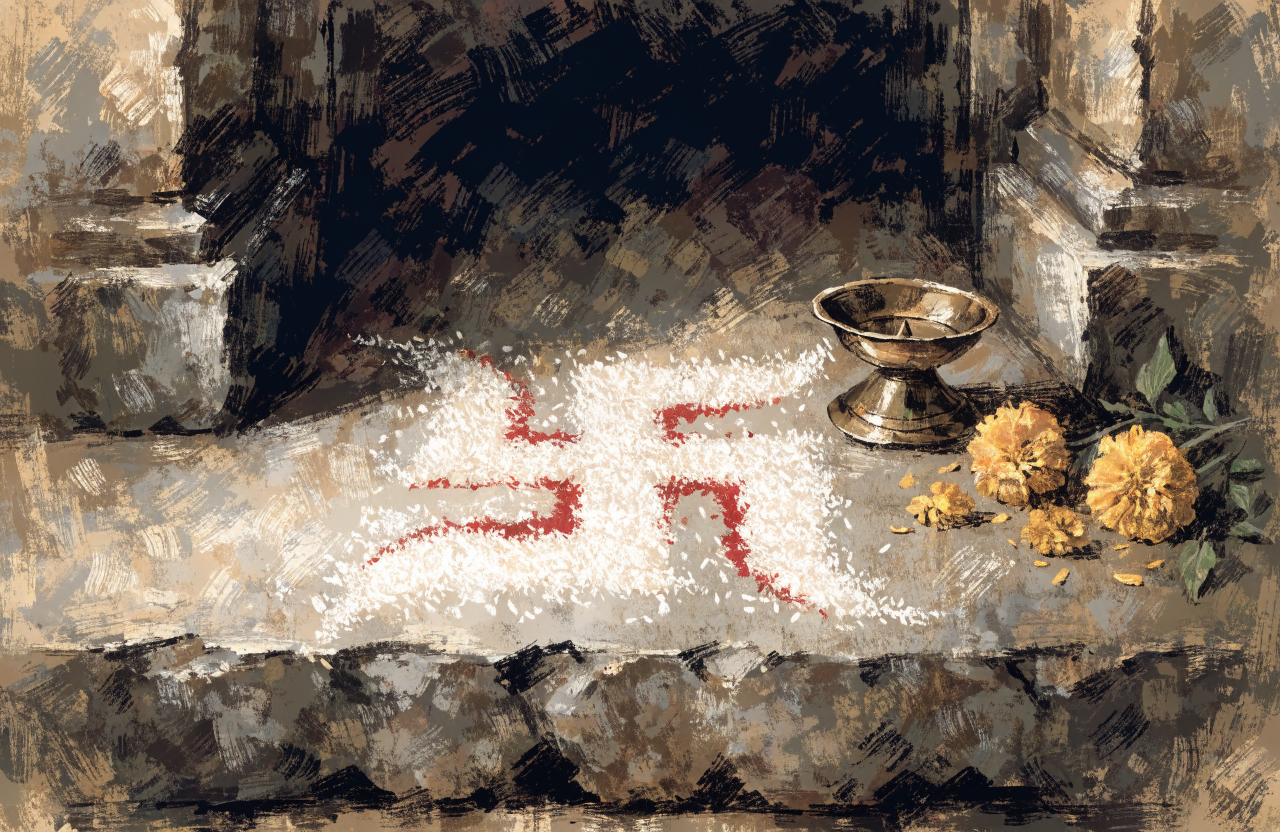
The svastika is a maṅgala — an auspicious mark, a drawn blessing. Its home is the threshold: the doorway of a house, the first page of the account book, the corner of a wedding card, the pot at pūjā, the rangoli at Diwali. At every beginning, it says the same quiet thing: let this go well.
Its oldest, plainest voice is in the Veda itself. There is a mantra still chanted today at the close of prayer — the svasti mantra — and it is simply the word of the svastika, sung aloud as a blessing.
स्वस्ति न इन्द्रो वृद्धश्रवाः स्वस्ति नः पूषा विश्ववेदाः ।
स्वस्ति नस्तार्क्ष्यो अरिष्टनेमिः स्वस्ति नो बृहस्पतिर्दधातु ॥
svasti na indro vṛddhaśravāḥ svasti naḥ pūṣā viśvavedāḥ |
svasti nas tārkṣyo ariṣṭanemiḥ svasti no bṛhaspatir dadhātu ||
"May Indra of great renown grant us well-being. May all-knowing Pūṣan grant us well-being. May Tārkṣya of unhindered flight grant us well-being. May Bṛhaspati grant us well-being."
What it means: four times the verse says the same word — svasti, "may it be well." The svastika is that prayer drawn as a picture: a small, hand-sized wish for the well-being of everyone who crosses this threshold. The mantra names well-being four times; the mark has four arms. Say that softly, as a resemblance, not a rule — but it is a lovely one.
The four arms are read many ways across the tradition — the four directions, the four Vedas, the four aims of life (dharma, artha, kāma, mokṣa), the four seasons, the turning of time. Not one fixed doctrine, but a family of readings around a single idea: the whole of things, turning. The mark is also widely associated with the wheel of the sun crossing the sky — motion, life, the year coming round again. And it is shared: Hindus, Buddhists (who see in it the heart-seal of the Buddha) and Jains all draw it. One symbol, many rooms of the same old house.
Two · The science
Its power is not in the air — and never needed to be
Let us be gentle and clear here, because this is where warm feeling reaches past what a drawn line can do. Unlike the bell, which really does fill a room with sound, or the lamp, which really does draw the eye, or the long Om, which really does slow the breath, a mark on a wall works differently — quietly, through meaning, not through the air. You will hear a few claims made for it, and it is kinder to everyone to meet them plainly:
- "The svastika emits positive energy." That is love talking, not physics — a shape does not give off a force. And the mark loses nothing by that; its power was never that kind.
- "Its angles channel a cosmic force or a special frequency." There is no field or frequency in the geometry. The wonder of the svastika lives somewhere else entirely.
- "Drawing it purifies the home." This is tradition and feeling, not a measurable change in the room — and it is worth keeping exactly as that: a wish made visible.
And here is the part worth marvelling at, far more than any energy field could ever be: this one small hand-drawn sign meant "good fortune" to billions of people, across a dozen cultures, on four continents, for something like five thousand years — and still does, this morning, on a doorway near you. That reach is astonishing all by itself. It needs no magic to be remarkable.
It emits no energy. Its angles channel no cosmic force. That is the plain truth of it. The astonishing part needs no physics: one small mark meant "may it be well" to billions of people, for five thousand years — and still does, this morning, on someone's step.
Three · The mind
A start button for the mind
Here is where the svastika's real, defensible power lives. A mark of beginning is a threshold ritual — a small, deliberate signal to yourself that something is starting, and I wish it well. It is the same reason people knock on wood, or take a breath and murmur "here goes." Marking a clean start lowers the low hum of anxiety and gathers the mind. The svastika is that ordinary human move, made beautiful and shared.
And it quietly primes you toward good faith. To step, every day, under a mark that means "may it be well" is a small repeated nudge toward hope and care rather than dread. Nothing supernatural — just a daily cue of intention, which is a real and useful thing.
Which brings us to the deepest point of all: a symbol means whatever a community agrees it means. Meaning is not sealed in the ink. It is made by the hands that draw and the hearts that read. Hold that thought — because everything difficult about this symbol turns on it.
Four · The many
A wordless welcome — and a clear reckoning
On a doorway, the svastika greets everyone who enters — no language, no doctrine, just "may it be well." Before the twentieth century, in the words of the Anti-Defamation League, its use was "almost always benign." It is one of humanity's most widespread signs of welcome, shared across faiths and continents.
And then there is the reckoning we must make with care and with gravity.
In 1920, the Nazi Party adopted a hooked cross it called the Hakenkreuz — "hooked cross" — and under that emblem carried out the Holocaust and the mass murder of millions of people. Because of that, in the Western world the tilted, hooked form became, and remains, a symbol of hatred, antisemitism, and unspeakable suffering. None of that is softened here. The horror is real, the grief is rightful, and the dead are owed our respect.
What follows is not a defence and not a grievance — only a distinction, stated as history:
- The Nazi emblem is a hooked cross, usually set on its point (tilted), on a red-white-black flag, adopted in the twentieth century for a racist ideology. A specific political object of the 1930s and 40s.
- The dharmic svastika is the upright maṅgala mark of the doorway and the account book — thousands of years older, and carrying the opposite wish: well-being for all.
The tilt is a useful cue, not an iron law — both marks can be drawn at other angles. What truly separates them is context, intent, and historyThe Anti-Defamation League — a body founded to fight antisemitism — puts it plainly: whether a swastika carries hateful meaning depends on the context and intent of its use. The religious use, it says, is "innocuous and without any hateful meaning." — the very point the ADL, an organisation founded to fight antisemitism, makes itself. It calls the religious use "innocuous and without any hateful meaning," and says whether a mark carries hate depends on its context and intent.
So name the threat correctly, because this is the heart of it: the threat was a specific twentieth-century regime and its behaviour — coercion, hatred, mass murder. The threat was never a people, never a community, never the mark on a grandmother's step. And restoring the older meaning is never, ever an argument against honouring the pain the Nazi symbol carries. Both can be held, with dignity, at once. That is not a clever trick. It is simply the truth. Hindu, Buddhist, Jain and Jewish groups have sat together in exactly this spirit — the 2008 Hindu–Jewish Summit acknowledged the symbol's ancient positive meaning while honouring what the Nazi emblem did — meeting the whole difficult thing not with anger, but with understanding.
So — what if you don't believe any of it?
Set aside every scripture and every claim of "energy." What remains is still worth having. The svastika is a five-thousand-year-old human sign for "may it be well" — older than every empire, shared by a dozen cultures. Learning what it actually meant, and how a single regime forced a different, tilted, hooked version onto the world for twelve terrible years, makes you two things at once: gentler in judgement, and harder to fool. You can honour the world's grief over one symbol without erasing the ancient meaning of the other. That is not a contradiction. That is maturity.
A small practice
Call it the threshold wish — about thirty seconds.
- The next time you begin something that matters — a new notebook, a first day, a new home, a new year — pause at its threshold.
- Make one small mark of good intention on the first page, and say the wish silently for everyone it will touch: may it go well.
- You are not casting a spell. You are doing exactly what the Veda does — naming, at the beginning, the hope that it goes well.
If the mark itself feels heavy to draw, given its twentieth-century misuse, then simply write the words — svasti, "may it be well." The words carry the whole meaning. That is the entire point: the blessing was never in the ink. It was always in the wish.
A symbol means whatever a people agree it means. For five thousand years the agreement was: well-being. For twelve years, one regime forced a different meaning onto a hooked copy of it. Both were real. Meaning is not in the ink — it is in the hands that draw, and the hearts that read.
The oldest word for a blessing is the shortest: it is well. Draw it, or simply say it — and mean it for everyone who comes after you.