Roots & Meaning · The Everyday Why
Why So Many Gods?
Somewhere, someone was made to feel small for it — "you people worship 330 million gods." The real answer is older, quieter, and far more beautiful than the caricature.
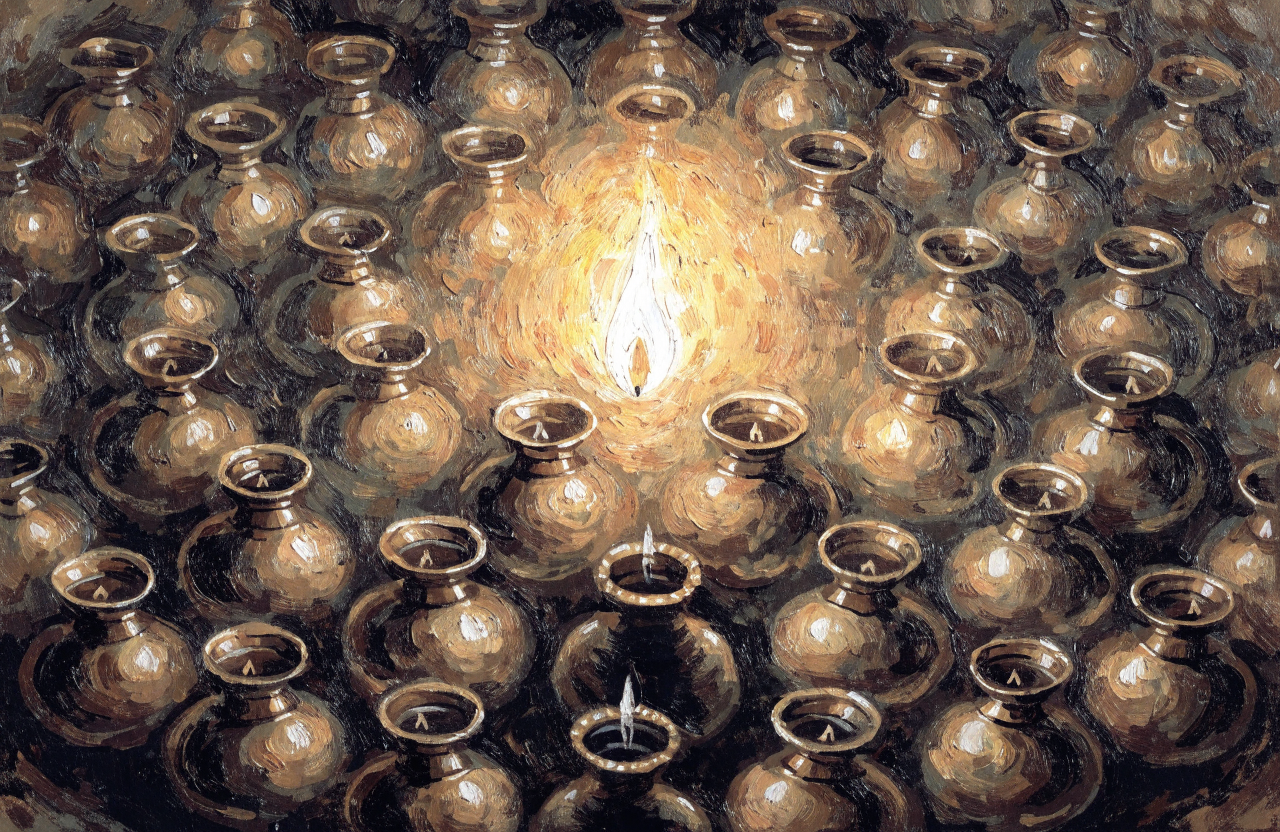
Hold a single flame to ten mirrors and you will count ten flames. No one in that room is confused about how many fires are burning. So why did anyone decide we were confused about God?
You have probably felt it.
A raised eyebrow. A half-smile. The line delivered like a checkmate: "So you worship — what — three hundred and thirty million gods?" And for a second you had no answer, because no one ever handed you one.
Here is the answer. It is not a comeback, and it is not a defence. It is simply the idea itself, laid out plainly — because once you see it, the caricature quietly falls apart on its own. We will walk it on four levels: the meaning, the arithmetic, the mind, and the many.
One · The meaning
One Reality, called by many names
Start with the oldest text there is. The Ṛg Veda — thousands of years old, the earliest layer of the tradition — already asks and answers this exact question. Its most famous single line is this:
इन्द्रं मित्रं वरुणमग्निमाहुरथो दिव्यः स सुपर्णो गरुत्मान् ।
एकं सद्विप्रा बहुधा वदन्त्यग्निं यमं मातरिश्वानमाहुः ॥
indraṃ mitraṃ varuṇam agnim āhur atho divyaḥ sa suparṇo garutmān
ekaṃ sad viprā bahudhā vadanty agniṃ yamam mātariśvānam āhuḥ
"They call it Indra, Mitra, Varuṇa, Agni — and it is the divine, beautiful-winged Garutmān. The Real is one; the wise speak of it in many ways. They call it Agni, Yama, Mātariśvan."
What it means: the oldest scripture already settled the question. There is one Reality. The wise never mistook the many names — Indra, Agni, Varuṇa — for many separate ultimate gods; they knew they were naming the one Real in many ways. Four words carry it: ekaṁ sad viprā bahudhā vadanti — "the Real is one; the wise call it by many names."
So the picture was never a crowd of rival gods squabbling for the top job. The picture is one infinite Reality — the tradition's word for it is Brahman — approached through many names and forms. This is a way of seeing, offered as it has always been offered: one boundless whole, met by finite people through the doorways they can reach.
Why doorways at all? Because a human heart cannot love an abstraction. "Meditate on the formless infinite" is a fine instruction and an impossible one for most of us on most days. So the same one Reality is met with form and quality — as Viṣṇu, Śiva, Devī, Gaṇeśa — a face you can actually turn toward. The form is a door, not the destination.
The old image is the sun and its reflections: one sun, seen in a lake, a mirror, a single dewdrop. Many reflections, one sun. Each reflection is real and useful — and no one ever mistakes it for a second sun.
A sage was asked, "How many gods are there?" He said, "Three thousand three hundred and six." Pressed, he said "Thirty-three." Pressed again — "Six." "Three." "Two." "One and a half." "One." He was not losing count. He was teaching you how to see.
That is not a parable we invented. It is a real conversation in one of the oldest Upaniṣads — the sage Yājñavalkya, questioned by Śākalya, walking the number of gods steadily down to one, explaining that the many are only the powers and glories of the few, and the few of the One. The tradition refutes naive polytheism from inside its own oldest canon, roughly twenty-seven centuries ago. The "confused idol-worshipper" is being asked a question Sanātana Dharma answered before most of the world's current arguments were born.
And there is a genuinely humane idea folded into this — the iṣṭa-devatā, the "cherished deity." You are allowed to choose the form of the divine that fits your own temperament and stage of life. A calm seeker may love Śiva; a devoted heart, Rāma or Kṛṣṇa; a mother, Devī. This is not fragmentation. It is personalisation. The tradition builds in the freedom to reach the One by the door that opens for you — without ever asking you to slam anyone else's door shut.
Two · The arithmetic
Not 330 million. Thirty-three.
Let us be straight about the big number, because clarity is the whole point here — and the true picture is more interesting than either the taunt or the tidy comeback.
The "one Brahman" behind it all is a philosophical vision, not a thing to be weighed on a scale — and it stands proudly as that. What we can do here is simply get the count right.
- The scriptural count is thirty-three. Across the Vedic corpus — and in that same Upaniṣadic conversation above — the principal devatās number thirty-three, not 330 million. The classical composition is 12 Ādityas + 11 Rudras + 8 Vasus + 2. That is the textual fact.
- The popular "types, not crore" line is reasonable — but not a knockout. You will often hear that the Sanskrit word koṭi means "type / kind," not "crore" (ten million), so it was always "33 types of gods" and "330 million" is a pure mistranslation. Half of that is solidly true: koṭi genuinely is a homonym — it can mean "ten million" and "edge, degree, class, kind." So reading it as "kind" is linguistically fair, and many teachers favour it.
- But it is an interpretation, not a slam-dunk. The oldest and most authoritative statements simply say thirty-three — the plain number — with no "koṭi" attached at all. The larger figure shows up in later, looser usage. So the cleanest statement is this: the core count is thirty-three; where a bigger number appears, "kind/degree" is a well-grounded reading of koṭi — but it is a reading, not proof that everyone who ever said "crore" was simply ignorant.
And two things this piece will gently leave aside. You will sometimes hear that "33" secretly encodes vertebrae or frequencies or energy centres — that is modern folk symbolism, charming but late, not scripture. And you will hear the gods described as hidden physics with the equations filed off. Many devatās are beautifully named powers of nature — Agni is fire, Vāyu is wind, Uṣas is dawn, Sūrya the sun — and to revere them is to revere the one life shining through many windows. That is poetry and cosmology of the highest order, and it needs no lab-coat to be true. Naming a thing sacred is its own kind of knowing — a different language from a law of thermodynamics, and lovely on its own terms.
Either way, the number was always making the same point the Upaniṣad makes out loud: behind every count is the One.
Three · The mind
A face you can love, and a fight you never have to pick
Set the metaphysics aside and look at what this does to a human being.
- A form beats an abstraction. Attention needs an object. Tell a grieving or striving person to contemplate the formless infinite and you will usually lose them. Give them a face — a Rāma, a Devī, a Gaṇeśa — and the mind has somewhere to rest and someone to relate to. The iṣṭa-devatā is, quite simply, wise psychological design: it meets the mind where it actually is.
- Personal fit keeps a practice alive. Choosing the form that suits your own temperament — fierce or gentle, austere or tender, mother or friend or teacher — is the difference between an exercise you quit and one you return to. The One does not change; your doorway to it just fits your hand.
- Plurality lowers the temperature. A worldview in which your path and my path can both be true — different names for one Reality — is quietly disarming. It removes the anxious "I must be right and you must be wrong" that drives so much conflict, outward and inward. For a tired, over-argued mind, the permission that there are many valid doors is itself a kind of rest.
Four · The many
The same One, everyone's
This is where the idea does its most important work.
Because the many names all point to one Reality, the tradition never needed a single compulsory name, a single book, or a single door. That is why it could hold, under one wide roof, the devotee of Śiva, the devotee of Viṣṇu, the worshipper of the Goddess, the philosopher of the formless, and the small village shrine — none of them a heretic to the others. Plurality here is not a mess to be tidied. It is the social shape of ekam sat.
Follow it to its end and you reach the deepest anti-fanatic idea the tradition carries. If the Real is one and merely called by many names, then the divine that other people reach for, by other names, is not a rival — it is the same One, differently addressed. This is not a competition to be won. It is a kinship to be recognised. Naming the unnameable by many names is a human impulse, found the world over; Sanātana Dharma simply keeps that plurality visible and welcome instead of hiding it. Ekaṁ sad viprā bahudhā vadanti — the Real is one; the wise call it by many names — and that "the wise" was never meant to mean only ours.
So what does the tradition actually resist? A behaviour, never a people. It resists mockery, contempt, coercion, the shaming of someone off their own path, the demand that everyone name the One your way. Not a community, not a faith, not a "them" — a behaviour. When someone sneers "you worship 330 million idols," the answer is not a counter-sneer. It is understanding, calmly held: the Real is one; we have simply never been afraid to give it many faces.
So — what if you don't believe any of it?
Then set aside every verse and keep this. A worldview that says "the truth is one, and your name for it and mine can both be right" is not confusion — it is the opposite of fanaticism. It hands a restless mind a face it can love, and it removes any reason to hate someone for loving a different one. That is a saner place to stand than most, and you do not have to accept a single line of scripture to see it.
A small practice: name your one door
You do not need a shrine or a ritual for this. A name and a breath is enough.
- Tonight, take thirty seconds and ask honestly: of all the forms the divine is given — the calm ascetic, the protective mother, the playful friend, the remover of obstacles, or simply the formless silence — which one does my heart actually reach for? Don't justify it. Just notice it. That is your door.
- Return to that one form for one minute a day this week. Not to argue for it — just to stand at it.
- Notice what it does not require: you never have to close another door to walk through your own.
Choosing one face of the One is not smaller than the whole. It is how a finite heart holds the infinite.
You were told your people worship 330 million gods. The scriptures count thirty-three — and then spend their deepest pages insisting even those are one. The big number was never the belief. It was only ever the caricature.
The Real is one. We were simply never afraid to give it many faces — and never asked you to give up yours.