Roots & Meaning · The Everyday Why
Why Do We Bathe the Deity in Pañcāmṛta?
The bath itself is no mystery — every pūjā has its snāna. The quieter questions are the sweeter ones: why these five, milk and curd and honey and ghee and sugar, poured slowly by hand? And why, of all the gods, does Śiva most love to be bathed?
You do not bathe the stone because it is dirty. You bathe it because you are.
Watch an abhiṣeka and the first thing you notice is how slow it is.
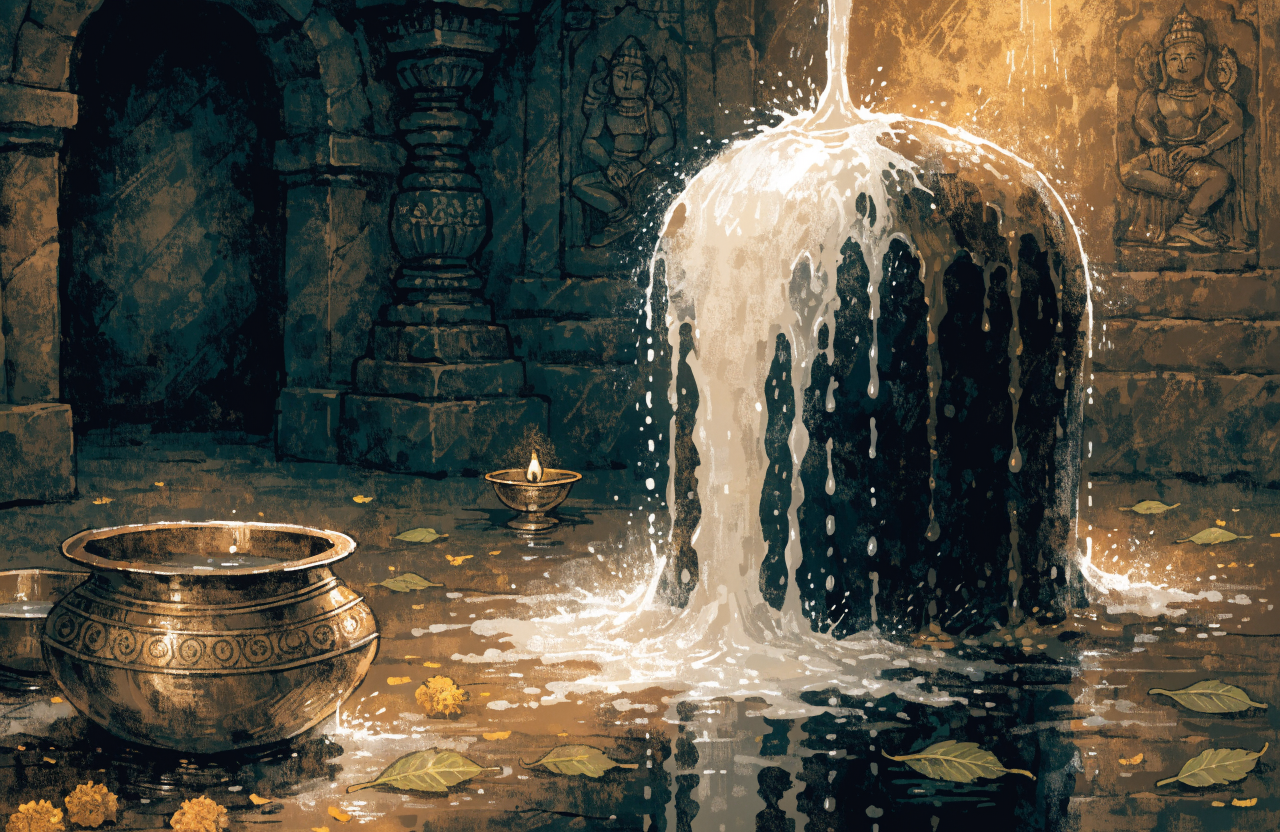
Water, then milk. A pause. Curd, honey, ghee, sugar. Coconut water, cool and clear. Sandal-paste smoothed by hand over the form, while a low, steady chant fills the room. The bathed image gleams. Then it is dried, dressed, and adorned as if it were the most honoured guest in the house.
Which is exactly the point. Abhiṣeka is hospitality made physical. And it looks, to an outsider, like a strange amount of trouble to take over a metal or granite figure. Here is what is really going on — read across four levels: the meaning, the nectars, the mind, and the many.
One · The meaning
You are not worshipping a stone. You are hosting a presence.
Indian worship rests on one radical idea about guests: atithi-devo-bhava — treat the one who arrives as you would treat the divine. Traditional temple worship simply turns that around. It treats the divine as you would treat the most honoured guest.
So the deity is received the way you would receive a traveller arriving dusty from a long road. You seat them. You wash their feet. You offer water to sip. And then — you draw them a bath. That bath is the abhiṣeka. In the traditional sixteen-fold service (ṣoḍaśa-upacāra, an Āgama and temple practice, not a single scriptural command), it is simply the snāna, the bathing step, done with love.
The classic soundtrack to the bathing of Śiva is the Śrī Rudram — and it is worth hearing what that hymn actually is. It is a garland of salutations, one bow after another, to a God the hymn calls fierce. It opens like this:
नमस्ते रुद्रमन्यव उतोत इषवे नमः ।
नमस्ते अस्तु धन्वने बाहुभ्यामुत ते नमः ॥
namaste rudra manyava uto ta iṣave namaḥ
namaste astu dhanvane bāhubhyām uta te namaḥ
"Salutations to you, Rudra — to your fierce power, and salutation to your arrow; salutation to your bow, and salutation to your two arms."
What it means: the whole hymn is just namaḥ — "I bow" — said again and again, even to what is frightening. Abhiṣeka is that same bowing turned into touch. Instead of only saying "namaḥ," you pour, you serve, you cool. It is the salutation you can feel on your hands. And notice the move the hymn makes: it bows to the fierce power in order to soften it. The cool water and milk of the bath do the same thing — care converts fear into intimacy. The devotee soothes the fierce Rudra into the kindly Śiva.
There is a second meaning hidden in the word itself. Abhiṣeka also means anointing — the way a king was consecrated, crowned, poured over at his coronation. So to bathe the deity is also to crown it: to install, deliberately, what you want to rule your life. You pour over the thing you have chosen to let govern you.
And there is a reason the ablution, of all the services, sits at the very heart of Śiva worship. An old saying sorts the gods by what most delights each of them: abhiṣeka-priyaḥ śivaḥ, alaṅkāra-priyo viṣṇuḥ — Śiva loves the bathing; Viṣṇu loves the adorning. (The same little verse goes on: the Sun loves the bow — namaskāra-priyo bhānuḥ, which is why we have Sūrya namaskāra.) It is a piece of tradition, not a rule — but it tells you something true about temperament. Viṣṇu is served most tenderly through alaṅkāra: silk and sandal, jewels and garlands, the beloved dressed in beauty. Śiva — the ascetic who wears ash and needs nothing — is reached instead through the plainest, most bodily act of care there is: cool water and milk, poured without stop. So the great Rudrābhiṣeka bathes the Śiva-liṅga for hours, while a Viṣṇu shrine lingers instead over the dressing and the flowers. The same love, spoken in two languages — each god met the way that god is loved.
And the substances themselves are a wordless language. Water for life and cleansing; milk for nourishment; curd for prosperity; honey for the sweetness of speech; ghee for strength; sugar for the sweetness of the bond. Pouring them, one by one, says a single sentence without words: take my best — I keep nothing back.
Two · The five nectars
What the pañcāmṛta is
The classic bath is the pañcāmṛta — pañca (five) + amṛta (nectar, "the deathless") — five things poured in turn: milk, curd, honey, ghee and sugar, often followed by coconut water, sandal-paste and more. Each is a wholesome food, and each carries a plain meaning: milk for nourishment, curd for prosperity, honey for sweet speech, ghee for strength, sugar for the sweetness of the bond. Poured one by one over the form, together they say a single wordless sentence: take my best — I keep nothing back.
And they are, quite simply, good things. Honey really does slow bacteria — it holds almost no free water, it is acidic, and it releases a little hydrogen peroxide. Curd carries live cultures; milk and ghee are old, nourishing foods; sandal and camphor cool and calm. Mixed together and taken afterward as a spoonful of prasāda, pañcāmṛta is a small, wholesome sweet — the goodness of its ingredients, gathered into one offering.
The tradition holds something more: that the bathed water — the tīrtha — and the pañcāmṛta carry a blessing, that they do the one who receives them good. Has a laboratory measured that? No. And here is a thing worth saying plainly, because a great deal of breath gets wasted arguing it: a practice does not need science's permission to be worth keeping. Where science happens to find the goodness in something old, wonderful. Where it has not looked, or not yet found it, nothing about the practice changes — it means only that science has not caught up, and science has a long habit of catching up late. Ghee was demonised for a generation, then quietly vindicated. Charcoal and salt were mocked as tooth-cleaners for forty years — and now sit in the very tubes that once mocked them. So we make no anxious case and offer no apology: the devotee who takes the tīrtha with faith feels steadied, cared for, sent back into the day a little lighter — and that is real, whatever runs beneath it. If the science one day arrives, we will welcome it warmly. If it never does, all is well regardless.
Three · The mind
Forty minutes of undivided care
Strip away belief for a moment and look at what the body is actually doing during an abhiṣeka. It is doing one thing, slowly, with both hands, for a long time. Pour. Wait. Watch the milk sheet over the form. Chant. Pour again.
In a life that is interrupted every few minutes, that is rare and valuable. It is a single-tasking ritual: for those minutes your whole attention rests on one small act of service, with no phone and no agenda. That focused, unhurried attention is calming on its own, whatever you believe about the image.
And there is a second, quieter effect. Doing something for another — even a symbolic other — turns down the "me-first" hum that anxiety runs on. The posture of a servant is the opposite of self-absorption. Bathing the deity gently rehearses a tenderness and humility you can carry back to the people in your house.
Water poured on a god runs off in seconds. So why pour it for forty minutes? Because the pouring was never for the god. It was to slow you down enough to mean it.
Four · The many
One bath, shared out
In a temple, an abhiṣeka draws a crowd — and then the bathed substances are handed out to everyone as tīrtha and pañcāmṛta. Each person receives the same small spoonful. It is a quiet levelling: the priest and the stranger get exactly the same.
It also teaches without a lecture. A child watching an elder pour with such care learns reverence, patience and gentleness by seeing them — values passed down the generations through the hands, not through a sermon. And the rhythm of it — the Monday abhiṣeka, the great baths of Mahāśivarātri — knits a community to a shared calendar and a shared place.
So — what if you don't believe any of it?
Then keep this. Strip out the divinity and you are left with a person giving forty minutes of slow, careful, two-handed service — full attention, no phone, no agenda — pouring cool, clean things to a steady rhythm. That is a focus practice, a humility practice and a shared meal, all at once. The milk and honey are just milk and honey; their worth is real but ordinary, not magical. What is genuinely valuable here is not a "charged" liquid. It is the rare experience of giving your undivided care to something outside yourself. That works whether or not the image is anything more than stone.
A small practice
Try the two-minute abhiṣeka of attention.
- Each morning, pick one thing to care for — a tulasī plant, a photo of someone you have lost, or simply a bowl.
- Pour a little clean water over it, or for it, slowly, with both hands. Say one line of thanks aloud. Phone away. Two minutes, no more.
- Make no claim of magic. It is simply deliberate, unhurried service — a way to start the day from giving rather than grabbing.
If you keep pañcāmṛta prasāda, make it fresh, with clean hands, and take a symbolic spoonful — never for a baby under one year, because of the honey.
An honoured guest arrives. You would not hand them a certificate of your love. You would draw them a bath. The deity gets the bath — and you get to remember how it feels to serve.
The stone was never thirsty. The pouring was always for the one who pours.