Roots & Meaning · The Everyday Why
Why Worship Five Gods at Once?
Five deities on one plate — Śiva, Viṣṇu, Devī, Sūrya, Gaṇeśa — worshipped together, as equals. It looks like indecision. It is one of the oldest peace treaties ever designed.
Two neighbours once nearly came to blows over whose god was greater — Śiva's or Viṣṇu's. The tradition's answer was not a winner. It was a plate. Put both on it. Bow to both. The quarrel was never between the gods; it was between the men.
Look closely at an old family shrine and you may notice something strange.
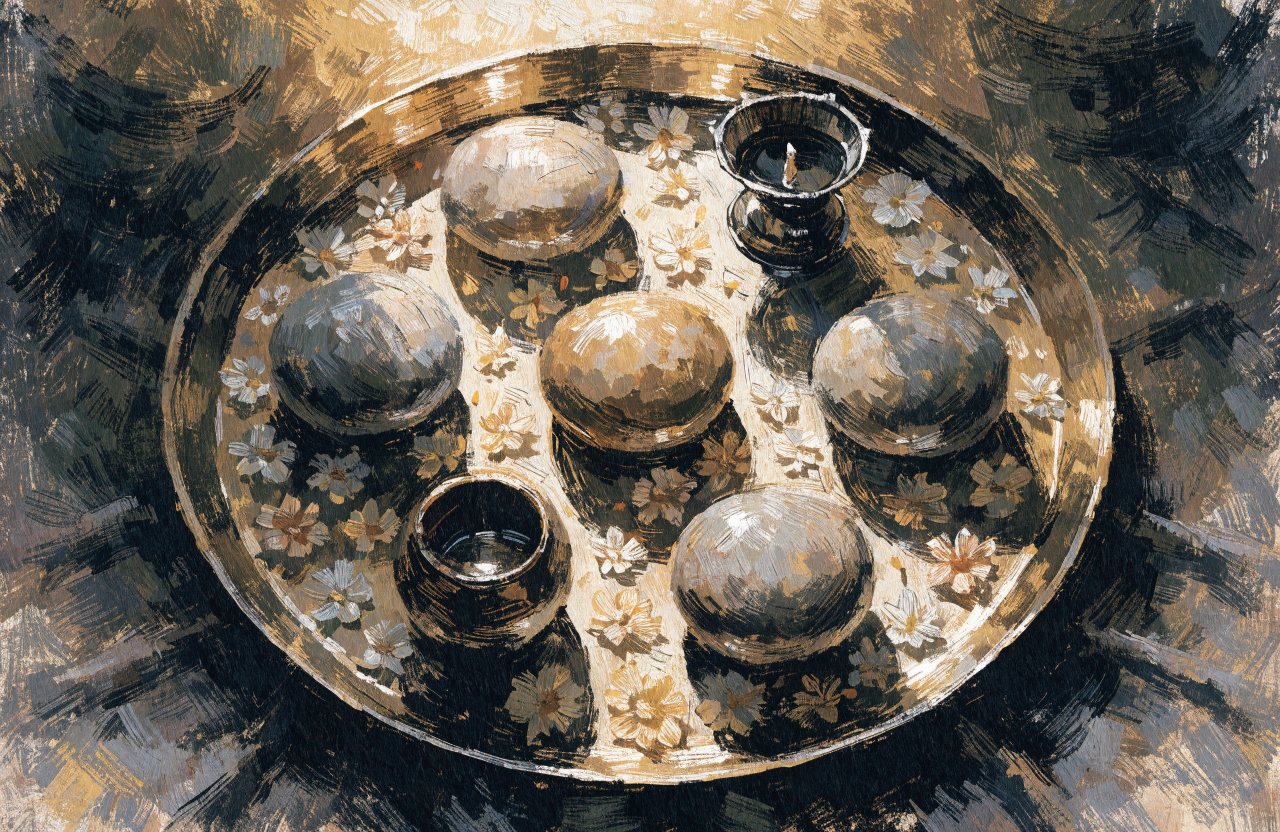
Not one deity, but five — often five small stones, or five little images, set out together on a single tray: Gaṇeśa, Sūrya, Viṣṇu, Śiva, and Devī. One in the centre, four at the corners, like the five spots on a die. This is pañchāyatana pūjā — the "five-shrine" worship.
Why five? Why not simply choose your favourite and be done? The answer is quietly one of the wisest things the tradition ever did. Here it is on four levels — the meaning, the material, the mind, and the many.
One · The meaning
A peace treaty you can hold in your hands
For long stretches of history, the great streams of worship did not always sit easily together. Those devoted above all to Śiva, those devoted above all to Viṣṇu, to the Goddess, to the Sun — each held their chosen form to be supreme. Rivalry was real.
The five-shrine plate is the answer to that rivalry, made of brass. It takes the streams that had competed and places them on one surface, as equals, worshipped in a single sitting. You don't have to be told that the divine is one; you do it, every morning, with your hands.
And notice the shape it takes. Your chosen form of God sits at the centre — devotion stays personal and warm. The other four are honoured around it — openness stays real. It refuses two mistakes at once: the cold "all gods are the same, so I love none," and the narrow "only my god is real." A third way, older than both.
The tradition even puts this into the mouth of the victor. In the Viṣṇu Purāṇa, after a great battle, Kṛṣṇa (Viṣṇu) stands over the field — and says the one thing a winner never says.
त्वया यदभयं दत्तं तद्दत्तमखिलं मया ।
मत्तोऽविभिन्नमात्मानं द्रष्टुमर्हसि शङ्कर ॥
योऽहं स त्वं जगच्चेदं सदेवासुरमानुषम् ।
मत्तो नान्यदशेषं यत्तत्त्वं ज्ञातुमिहार्हसि ॥
tvayā yad abhayaṃ dattaṃ tad dattam akhilaṃ mayā
matto 'vibhinnam ātmānaṃ draṣṭum arhasi śaṅkara
yo 'haṃ sa tvaṃ jagac cedaṃ sadevāsuramānuṣam
matto nānyad aśeṣaṃ yat tat tvaṃ jñātum ihārhasi
"The safety you granted, I too have granted; O Śaṅkara, you should see me as not separate from your own self. What I am, that you are — and so is this whole world, with its gods, its demons and its people. There is nothing at all apart from me; know this here and now."
Viṣṇu Purāṇa 5.33.47–48
What it means: even the "winning" deity says there is no winner. Viṣṇu and Śiva — and the whole world — are one reality seen from different sides; the sense of rivalry is our own confusion. Worshipping the five together on one plate is that verse turned into a daily habit. The peace treaty is self-signed, by the very god who was supposed to have won.
You will hear this idea in its shortest form in an even older line — the Ṛg Veda's ekaṃ sad viprā bahudhā vadanti, "the Real is One; the wise call it by many names." The five-shrine plate is that single sentence, laid out where your hands can reach it.
Two · The material
Real stones, with real stories
The five are often represented not by images but by five kinds of natural stone — and the stones themselves are quietly wonderful. The śālagrāma that stands for Viṣṇu is an actual fossil — an ammonite, a marine creature turned to stone over tens of millions of years, gathered from the bed of the Gaṇḍakī river in Nepal. The bāṇaliṅga that stands for Śiva is a naturally smoothed ovoid stone from the Narmada. That a household's worship rests on a genuine fossil and a river-polished stone is a lovely thing — geology and history, held in the palm, worth pausing on.
You will also hear that the five stones, arranged in their pattern, "generate" or "concentrate energy" — a kind of power grid of geometry. That is a piece of symbolism, and a lovely one; the arrangement doesn't need to be a power source to do its work. Its real power is of another kind altogether — what it does to the people who bow before it — and that turns out to be more than enough.
Five stones on a tray. Some will tell you the geometry generates energy. But what the five stones actually do is harder and rarer than any energy: they teach a proud man to bow to his neighbour's god.
Three · The mind
Holding more than one truth at once
There is a real, ordinary discipline hidden in worshipping five forms rather than one. The mind loves a single right answer, with everything else declared wrong. Deliberately holding several legitimate images of the ultimate — "my form and yours are both true" — is a quiet training against that pull. What you rehearse on the plate, you carry into how you meet people who differ from you.
The five can also be read as parts of a whole life a person must tend to:
- Gaṇeśa — clearing obstacles, beginning well.
- Sūrya — light, clarity, seeing what is.
- Viṣṇu — sustaining, keeping order.
- Śiva — transformation, letting go.
- Devī — power, nurture, protection.
Worshipping all five is a small, regular audit of the whole self — not a menu to pick one strength and neglect the rest. And like any fixed daily ritual, the sitting itself steadies attention and marks the day. The good there is the rhythm — the ordinary, well-understood ease of a calm repeated routine.
Four · The many
How you build a peace that lasts
This is the deepest thing the plate does. In a time of real friction between communities of worship, the response was not a decree that everyone must now agree, or that all gods are "really the same, so it doesn't matter." It was something far cleverer: a ritual form in which each family keeps its beloved deity at the centre and still bows to the others.
That is how durable peace is actually made — not by erasing difference, but by building respect for difference into the daily act of worship itself. No stream is ranked below another. The centre-deity is simply the worshipper's own choice, not a verdict on the gods. Rooted, and open.
In a joint family where different members love different forms, the plate lets everyone worship together, at one tray, without anyone's chosen deity being pushed aside. Social glue, at home. And it scales up: it is a working picture of how people who hold their own faith strongly can still live as one family — vasudhaiva kutumbakam — without demanding sameness.
A note on history
Reformer, not inventor
You will often hear that Ādi Śaṅkara (around the 8th century) created the five-shrine worship. It is fairer to say he gave it its classic shape and its philosophy. The five-shrine layout is genuinely older than him: such arrangements survive in temple designs from the Gupta era (4th–6th century), and one set from the village of Nand is dated all the way back to the Kushan period, before 300 CE — centuries before Śaṅkara was born.
So the picture is this: he most likely standardised and gave a meaning to a practice already in the ground, rather than inventing it from nothing. A reformer and organiser of something living — which, if anything, makes it older and deeper than the tidy origin story suggests.
So — what if you don't believe any of it?
Then keep this. The five-shrine plate is one of the oldest pieces of conflict-resolution design human beings ever made. It lets people keep their own faith firmly at the centre and still bow to their neighbour's — which is exactly the skill a plural, crowded world runs on. No energy fields required; the social engineering is the marvel. If you ever have to hold a room where people hold their beliefs hard and differently, you could do worse than study a plate of five.
A small practice — the five-fold bow
You need no stones and no shrine. It takes about two minutes.
- Sit quietly and bring to mind five things you tend to keep separate: a fresh start you owe someone (beginnings), a truth you have been avoiding (light), an order you must sustain, a thing you must let go of, and a strength you must protect.
- Give each one a slow breath and a small inner bow. None ranked above the others.
- Then, if you hold a faith, bow once to your chosen form — and once, deliberately, to a form that someone you disagree with holds dear.
That second bow is the whole of pañchāyatana: your centre kept, your neighbour honoured.
Notice the shape once more: your god in the centre, four others around. Not "all gods are equal, so love none." Not "only mine is real." Love yours fully — and honour that your neighbour's is the same One.
The victorious god was the one who said there is no victory. That sentence, laid out where your hands can reach it, is a plate of five.