Roots & Meaning · The Everyday Why
Why Do We Greet with Namaste?
Palms together, a small bow, no touch. It is at once the most hygienic greeting on earth — and the most profound.
A handshake says: look, my hand is empty, I carry no weapon. Namaste says something braver — I see the divine in you. One greeting was born of fear. The other, of reverence.
The world reaches out a hand. We join our own two.
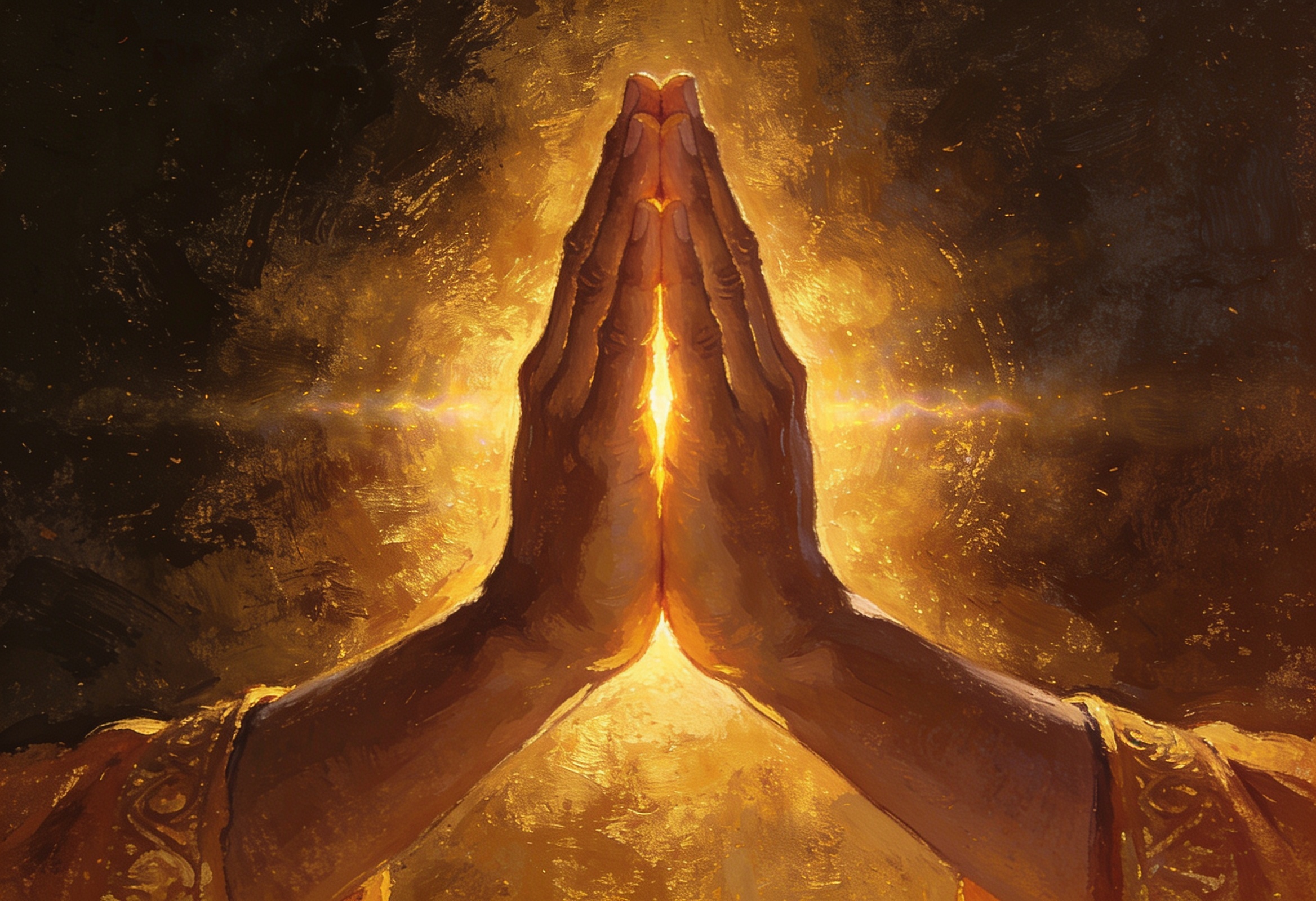
To an elder, a guest, a teacher, a stranger at the temple — palms pressed together, a slight bow, the word Namaste. No contact at all.
Why did our tradition choose not to touch? The answer runs on four levels — the meaning, the health, the mind, and the many. Even if you keep only the practical ones, the case is strong.
One · The meaning
You are bowing — but to what?
The word is simple: namaḥ ("I bow") + te ("to you") — "I bow to you." But you are not bowing to the person's body, or job, or wealth. You are bowing to the divine spark inside them.
सर्वभूतस्थमात्मानं सर्वभूतानि चात्मनि ।
ईक्षते योगयुक्तात्मा सर्वत्र समदर्शनः ॥
sarva-bhūta-stham ātmānaṁ sarva-bhūtāni cātmani
īkṣate yoga-yuktātmā sarvatra sama-darśhanaḥ
"The true yogi sees all living beings in God, and God in all living beings — with equal vision, everywhere."
What it means: Namaste is that verse turned into a gesture. You greet the same light in a king and a servant, a friend and a stranger, in exactly the same way. And the hands meet at the heart — because that is where you are meeting the other person, not at the level of status. In the word namaḥ there is also a quiet lowering of the ego: for one moment, you place yourself below the one before you.
Two · The health
Why a pandemic reminded the whole world
Now the plainest reason of all — and one the entire world relearned very recently:
- Namaste is touch-free. A handshake trades whatever is on two people's hands, and hands are how most everyday infections travel from person to person.
- In 2020, COVID-19 made this obvious overnight. Health authorities urged people to stop shaking hands. Leaders, doctors, and strangers around the world set the handshake aside and greeted instead with folded palms and a small bow — no contact, no transfer.
What our tradition arranged as reverence turned out to be, quietly, excellent public health. It was never designed in a laboratory. It simply worked — for thousands of years — and a pandemic made the wisdom of it visible to everyone. You do not need to believe a word of scripture to see that not gripping a hundred hands a day keeps you healthier.
Three · The mind
What the gesture does to you
- It is a small act of humility. Joining your palms and bowing slows you for a second and brings you present — you cannot do it while rushing past.
- It asks you to actually meet the person. A real Namaste comes with a moment of eye contact and attention, not a distracted grip while you look at your phone.
- It levels everyone. You greet a billionaire and a beggar the exact same way — no fumbling over rank, gender, or how firm the grip should be.
Four · The many
One gesture, a whole room
You can offer Namaste across a hall, to a whole gathering at once, from any distance — and you have greeted a hundred people with respect in a single motion. It carries none of the handshake's small anxieties: who offers a hand first, whether the other person wants contact, how long to hold on. Palms together settles all of it, gracefully.
So — what if you set the meaning aside?
Then keep the rest, and it is still unbeatable. Namaste is the most hygienic greeting there is. It works at a distance. It greets a group at once. It treats everyone as equal, with built-in respect. The world rediscovered every one of those in a single year — which is exactly why you now see Namaste offered on stages and in boardrooms far beyond India.
A small practice
Tomorrow, greet three people with a true Namaste:
- Bring your palms together at the heart, and bow your head very slightly.
- Give one second of real eye contact — actually see them.
- Hold the silent thought: the divine in me greets the divine in you.
Notice how different it feels from a hurried handshake. You did not touch — and yet you met the person more fully.
You do not touch, and yet you meet more completely. That was the point all along.
The hand that is not offered is not cold. It is folded — in front of the God it sees in you.