Roots & Meaning · The Everyday Why
Why Do We Draw a Rangoli at the Doorstep?
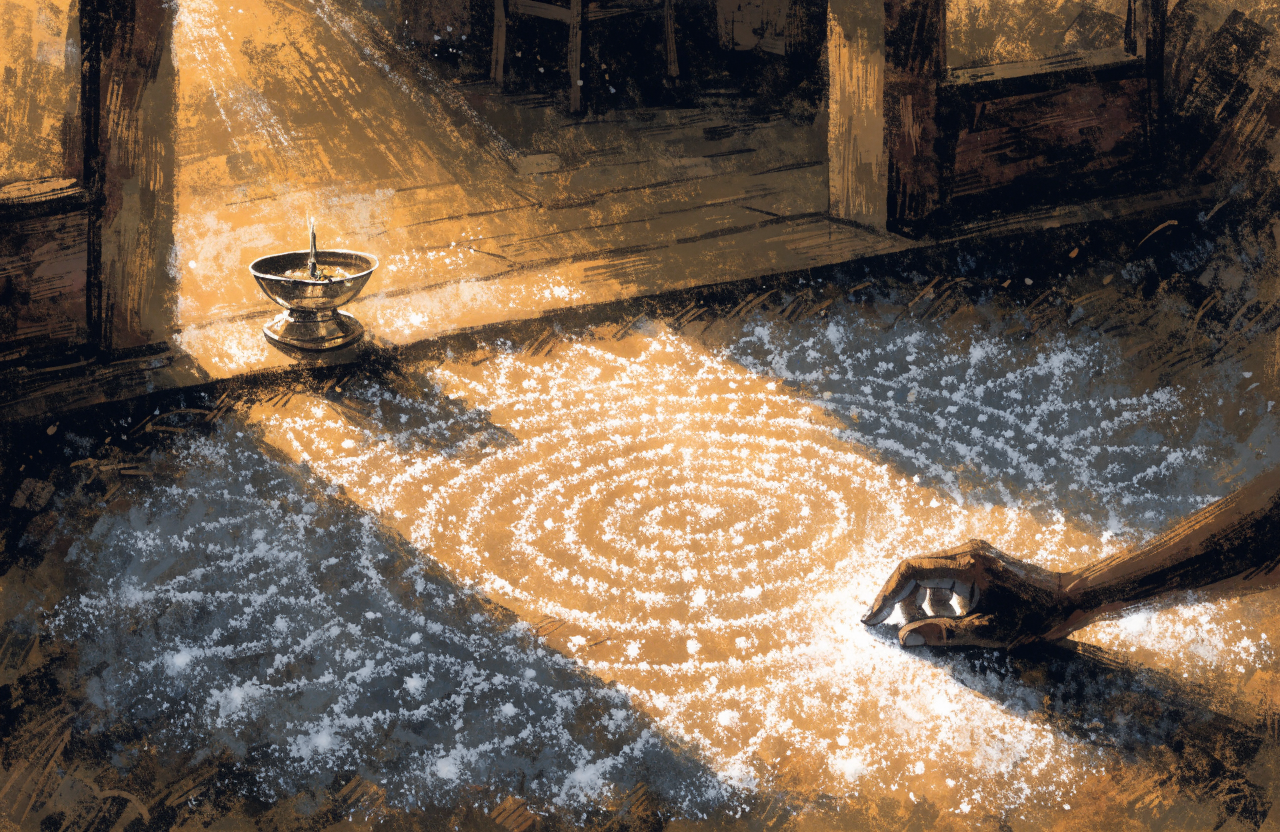
Before the day begins, she bends at the threshold and pulls a single white line around a grid of dots. It looks like decoration. It is closer to a theorem — and to breakfast for the ants.
The white loops on your neighbour's doorstep look like a pretty habit. They are closer to a theorem. A sikku kolam is one unbroken line — no start, no end, no loose thread — woven around a grid of dots by strict rules. Physicists classify them by symmetry and count them with formulae. Your grandmother was doing topology before breakfast.
Every dawn, in millions of homes, the same small act.
The doorstep is swept. A pinch of rice flour is taken between finger and thumb. And a design is drawn on the ground at the threshold — dots first, then lines looping around them. In Tamil it is kolam; in Telugu, muggu; in Sanskrit and much of the north, rangoli or rangavallī.
Why draw something so carefully, only to have it scuffed away by noon? It looks like the most pointless kind of beauty. In fact it is one of the most quietly intelligent things we do. Here it is on four levels — the meaning, the mathematics, the mind, and the many.
One · The meaning
Not a superstition. A learned art.
Here is the thing most people never hear. The tradition does not treat the doorstep design as a quaint village habit. It records it, by name, as one of the sixty-four arts — the catuḥṣaṣṭi-kalā — the cultivated skills a well-formed person was meant to learn.
In the Bhāgavata Purāṇa, Kṛṣṇa and Balarāma go to their teacher Sāndīpani's school and, in sixty-four days, master the sixty-four arts. In that enumerated list — beside painting, beside garland-making, beside music — sits the doorstep design.
तण्डुल-कुसुम-बलि-विकार
taṇḍula-kusuma-bali-vikāra
"the art of fashioning designs and offerings from rice-grains and flowers" — listed among the sixty-four arts Kṛṣṇa and Balarāma learned at their teacher's school.
What it means: the doorstep design isn't folk decoration the tradition shrugs at — it is named, in the canon, as one of the sixty-four arts worth mastering, in the same breath as painting and music. To draw a kolam is to practise a discipline: daily, by hand, with care. The very same art is listed in Vātsyāyana's Kāmasūtra too — which makes it, by scholars' reckoning, an art attested for roughly two thousand years.
And what is the design for? The tradition answers: it is a welcome. Drawn fresh each morning at the dehalī — the threshold between the street and the home — the kolam is an invitation, an āvāhana to Lakṣmī, to prosperity and auspiciousness. A house with a swept entrance and a fresh kolam is said to be ready to receive; one without is left to daridra, misfortune. This welcome to Lakṣmī is a living meaning, widely and beautifully held — real in the sense that matters: it is what the hands mean when they draw.
The tradition lists the doorstep design among the sixty-four arts — beside painting and music — that Kṛṣṇa himself went to school to learn. It is not superstition at the threshold. It is a discipline.
Two · The mathematics
A theorem drawn in rice flour
Now for the part that surprises everyone. Those looping white patterns are a serious object of study — in mathematics and in computer science.
The pioneer was Gift Siromoney, at Madras Christian College, who from the 1970s onward analysed kolams as "picture languages" — formal grammars, like the rules of a sentence, that generate the patterns. The loops that look freehand are, in fact, formally describable. There are rules underneath them.
A recent study makes those rules crisp. Physicist Venkatraman Gopalan classifies the sikku (loop) kolams by their symmetry and derives formulae counting how many exist in each type. The three structural rules he formalises are worth saying plainly:
- Every dot is individually encircled by the line — no dot is left touching the curve.
- Line crossings are clean, discrete points — the line passes over itself neatly, never smudging into a junction.
- There are no loose ends.
Put those three together and they force the sikku kolam to be one single, continuous, closed loop, woven around the whole grid of dots. That is genuine topology and group-theory, done by hand at a doorstep. Computer scientists study kolams precisely because they are algorithmic — a lattice of dots, strict rules, real symmetry. That is impressive entirely on its own terms. It needs no mysticism to be remarkable.
Three · The mind
A two-minute focus, before the noise
Drawing a kolam at dawn is a small, fixed, embodied ritual done before the day's noise begins. You bend, you dot the grid, you pull the line freehand around the dots. Like any hand-drawn morning ritual, it steadies attention and marks a clean start to the day. The good of it is in the focused doing — in the bending, the dotting, the steady pull of the line.
It is also a tiny creative act, every single day: the same dot-grid, a new pattern. Enough freedom to absorb you, enough structure to finish in minutes. A genuinely restorative little habit. You will see wellness pages call kolam "proven to improve health" — no need for that. It is a good habit on its own terms; it does not have to be medicine to be worth doing every morning.
And there is a quiet teaching folded in. You make something careful, and by noon it is scuffed by feet, blown by wind, eaten by ants — and tomorrow you make it again. The kolam is made to be erased. It is a small daily rehearsal of non-attachment: you did it for the doing, not to keep it.
Four · The many
It feeds the ants — it was never a wall
You have probably heard that the kolam "keeps negative energy out," or that "the powder repels pests by vibration." But the oldest, gentlest reason points the exact opposite way.
The traditional kolam is drawn in raw rice flour. And raw rice flour feeds the ants, the insects, and the small birds at the doorstep — a daily offering to the little lives at the threshold, made before the household itself eats. The scholar Vijaya Nagarajan documents and reads this at length in Feeding a Thousand Souls, framing it around the old idea of the householder's duty to feed a thousand souls. It is ahiṁsā in miniature — non-harm and generosity, built quietly into a morning chore.
Notice the irony: the kolam was never a barrier against small lives. It was breakfast for them. The "repels pests" story pulls the opposite way from the practice's own oldest meaning.
Beyond the doorstep, the kolam is social glue. It sits at the boundary the whole street can see — a fresh one each morning says the household is awake, clean, and welcoming. Patterns pass mother to daughter and neighbour to neighbour; on festival days — Pongal, the month of Mārgaḻi, Deepāvali — whole streets become a shared gallery you can read like a calendar. One threshold impulse, many hands, many names: kolam, muggu, rangoli, maṇḍana, alpana.
You have heard the kolam "keeps negative energy out" and "the powder repels pests." But the oldest reason points the other way: the rice flour is meant to feed the ants and the birds. It was never a wall against small lives. It was breakfast for them.
So — what if you don't believe any of it?
Then keep this. Drawing a kolam is a two-minute morning focus ritual and a genuine little exercise in symmetry and pattern — real topology under your fingertips. With real rice flour it quietly feeds the ants and birds at your door: a small daily kindness that needs no metaphysics. And it makes your entrance cleaner and more welcoming. None of that requires "positive energy" to be true. It just is.
The "feeds a thousand souls" reading holds only for traditional raw rice flour. Modern synthetic, stone, or chalk powders feed nothing, and some colours can be mildly polluting or contain irritant pigments. The old edible materials — rice flour, turmeric, flower petals — are the kind ones, in every sense.
A small practice
The dawn grid — about two to five minutes, before the day's noise.
- At your doorstep, or on a slate by the door, put down a small grid of dots — start tiny, a 3×3 of dots in chalk or rice flour.
- Now draw one continuous line that loops around and between the dots. Try not to lift your hand, and try not to leave a loose end — until the line closes back on itself.
- Don't aim for beautiful. Aim for one unbroken loop. Notice the small, clean focus it asks of you.
If you used real rice flour, you have also left a meal for the ants. And by evening it will be gone — ready to draw again tomorrow. That is the whole practice: a tiny daily discipline of attention, of symmetry, and of letting go.
She spends fifteen careful minutes on it at dawn. By noon it is gone — scuffed by feet, blown by wind, eaten by ants. And she will make it again tomorrow. The whole point is that it does not last.
A theorem drawn in rice flour, a meal for the ants, a two-minute peace before the day. All of it, given away by noon — and made again at dawn.