Roots & Meaning · The Everyday Why
Why Do We Circle the Deity?
You walk slowly around the sanctum, keeping the divine on your right. You are doing what the whole universe does — putting a still centre at the middle of your motion.
The planet does not race away from the sun; it circles it, and stays alive. Pradakṣiṇa asks a quiet question: what is the sun you are circling? Choose it well.
After the darśhan, you do not simply leave.
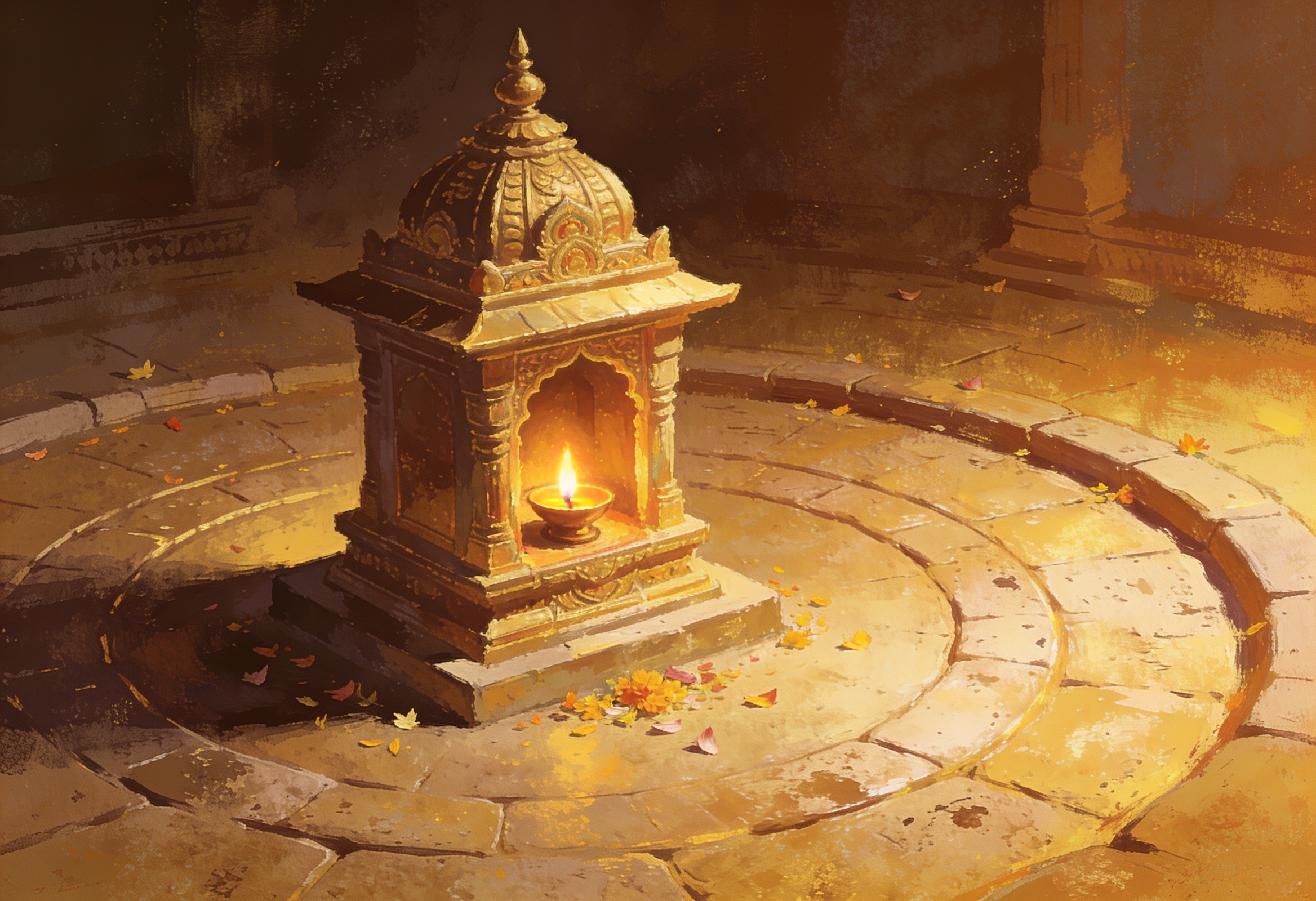
You walk — slowly, clockwise — around the sanctum, keeping the deity on your right, once or three times. We call it pradakṣiṇa.
Why walk in circles? It looks like the least efficient thing you could do. In fact it is one of the most quietly profound. Here it is on four levels — the meaning, the cosmos, the mind, and the many.
One · The meaning
You put the sacred at the centre
The word tells the story. Pra-dakṣiṇa: dakṣiṇa is the right side (the side of respect). You keep the divine on your right and move forward around it — you circle the sacred, holding it at the centre.
Read the geometry as a prayer. You place the divine at the centre and revolve around it. Your whole body is saying: let this be the fixed point of my life; let everything I do orbit around it. You are not the centre. You circle a centre higher than yourself.
मयाध्यक्षेण प्रकृतिः सूयते सचराचरम् ।
हेतुनानेन कौन्तेय जगद्विपरिवर्तते ॥
mayādhyakṣeṇa prakṛtiḥ sūyate sa-charācharam
hetunānena kaunteya jagad viparivartate
"Under My direction, material nature brings forth all beings, moving and unmoving; and for this reason, O Arjuna, the world revolves."
What it means: the Gita says the whole world revolves around its divine centre. When you circle the sanctum, you join that great turning on purpose — a small human echo of the deepest order there is: everything orbits the One. (There is even the old story of Gaṇeśa, who won a race "around the world" not by running it, but by circling his parents and saying, "you are my whole world." To circle the sacred is to declare: this is my universe.)
Two · The cosmos
The truest shape there is
Look up, and everything is circling. The moon goes round the earth, the earth round the sun, the sun round the heart of the galaxy. The circle-around-a-centre is the deep pattern of the universe — atoms to solar systems.
Pradakṣiṇa is that pattern, made human: a person choosing a centre and orbiting it. We are not claiming the ancients had telescopes. We are saying they built a practice on the truest shape in existence — and on the wisest life-lesson hidden inside it: find a worthy centre, and revolve around that. (You will also hear that you "absorb energy radiating from the sanctum" as you walk. That specific claim can't be measured — but what the circle does to your mind is very real, and that is next.)
Three · The mind
Walking meditation, discovered everywhere
Slow, rhythmic walking with a single focus quiets the mind. This is one of humanity's oldest tools, and — tellingly — it was discovered independently all over the world: circling a Buddhist stūpa, walking a cathedral labyrinth, the ṭawāf around the Kaaba. Different faiths, the same finding: move the body in a calm circle, hold one focus, and the restless mind settles.
Pradakṣiṇa turns a temple visit into exactly this — the feet move, the mind rests on the divine, and each loop carries you a little deeper into stillness.
Four · The many
One direction, one flow
Everyone circles the same way, in the same direction. In a crowded temple, that single rule quietly keeps order — it turns a pushing crowd into one moving, shared rhythm. A small, elegant piece of social design hidden inside an act of devotion.
So — what if you don't believe any of it?
Then keep this. A slow, mindful, clockwise walk around a fixed point is a proven way to calm and gather the mind — walking meditation, found in every tradition on earth. It is gentle movement. And it teaches one of the sanest lessons there is: put something higher than your own ego at the centre, and let your life orbit that. A person who circles a worthy centre does not spin out.
A small practice
- At the temple: walk pradakṣiṇa slowly, clockwise, the sanctum on your right, your mind resting on the divine — an unhurried loop, or three.
- Away from the temple: name your centre — a value, a purpose, the divine. When the day scatters you, ask: am I still orbiting it, or spinning off on my own?
- Come back to the centre. That returning is the practice.
A life without a centre does not stand still. It flies apart. So choose your centre — and circle it gladly.
Everything that lasts revolves around something greater than itself. Pradakṣiṇa simply asks you to do it on purpose.