Roots & Meaning · The Everyday Why
Why Do We Blow the Conch?
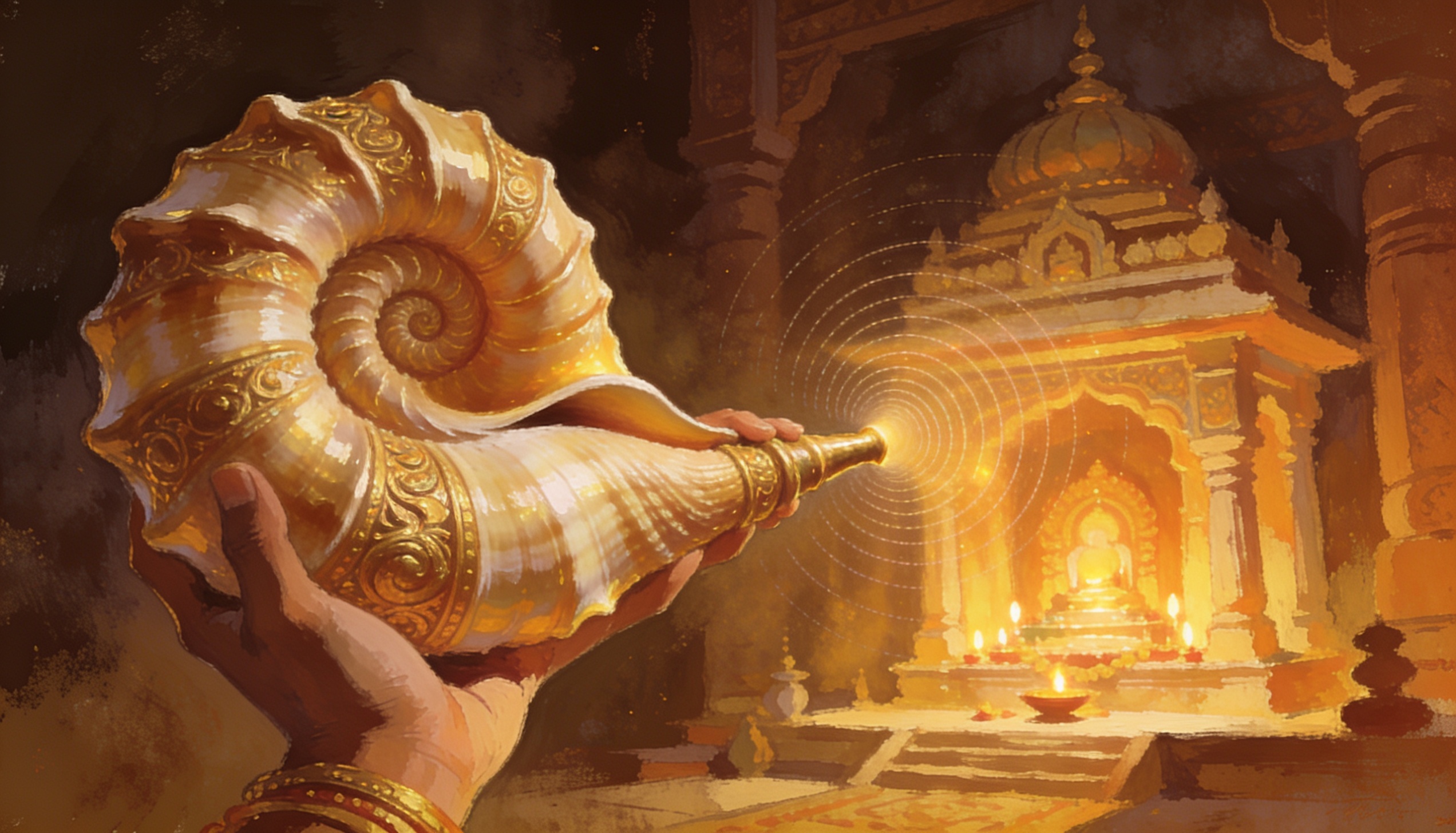
A hollow sea-shell, lifted to the lips. One long breath, and a deep note rolls out across the temple — and everything that was scattered turns, for a moment, to listen.
An ordinary sea-shell, emptied and raised to the mouth, becomes the sound that begins the sacred. Not the gold, not the fire — a hollow shell and a single breath. Maybe what makes a beginning holy is not its grandeur, but the full attention you sound it with.
The śaṅkha opens things.
A ritual, a festival, an aarti, once even a war for dharma — a long, low note from a spiral conch marks the moment it begins. The Mahābhārata opens its great battle not with a command but with a sound: on the field of Kurukshetra the mighty conches are raised together and blown — Krishna's Pāñchajanya, Arjuna's Devadatta, Bhīma's great Paundra — and the roar tears across the sky.
When that same conch is honoured in daily worship, the tradition greets it with its own invocation:
त्वं पुरा सागरोत्पन्नः विष्णुना विधृतः करे ।
पूजितः सर्वदेवैश्च पाञ्चजन्य नमोऽस्तु ते ॥
tvaṁ purā sāgarotpannaḥ viṣṇunā vidhṛtaḥ kare
pūjitaḥ sarva-devaiścha pāñchajanya namo'stu te
"You arose of old from the ocean, and were held in Viṣṇu's hand; worshipped by all the gods — O Pāñchajanya, salutations to you."
What it means: the śaṅkha is imagined as ocean-born and lifted into Viṣṇu's own hand — a plain sea-shell raised into something sacred. To sound it is to announce that a decisive moment has arrived: stop drifting; something real begins now. Long before it is mystical, it is a summons. (This is a traditional pūjā verse, honouring the conch — not a chapter-and-verse of scripture.)
Why open the sacred with a breath into a shell? It looks quaint. In fact it is doing four things at once — the meaning, the body, the mind, and the many.
One · The meaning
The first sound, and the sound behind all sounds
The conch is shaped like a frozen spiral of sound, and the tradition hears its long note as an echo of the first vibration — the praṇava, Om, the sound from which the cosmos is said to unfold. To blow the śaṅkha is to sound, in miniature, that primordial note at the threshold of worship.
Notice what the note actually is: not a tune, not words — just pure sound, held on one long breath. That is the point. Before language cuts the world into this and that, there is undivided sound; the conch lets you make it with your own body, and it is the closest a breath comes to a spoken Om. (The dedicated chapter on Om is next in this series.)
Two · The body
What the breath really does — and what the sound doesn't
First, the claim to set aside. You will often hear that the conch's sound sterilises the air, kills germs within its range, or clears "negative energy." There is no reliable evidence that the sound of a conch disinfects a room or removes anything from the air — leave that where it belongs. What is real, though, is stronger than most people realise:
- A genuine breath exercise. To make the note at all, you must draw a deep breath and release it in one long, forceful, controlled stream against the shell's resistance — working the diaphragm, throat and soft palate much like a wind instrument.
- Measured help for sleep apnoea — this is not folklore. In a 2025 randomised controlled trial (ERJ Open Research, of the European Respiratory Society), people with moderate obstructive sleep apnoea who practised conch blowing for about six months had fewer night-time breathing pauses, higher blood-oxygen, and roughly a third less daytime sleepiness than a deep-breathing control group — because the forceful blowing strengthens the very throat and soft-palate muscles that collapse during apnoea. A sea-shell, quietly holding its own next to a CPAP machine.
- A calming out-breath. The long, slow exhalation the conch demands is, by itself, one of the more reliable ways to settle the nervous system toward its "rest" state. (You will also hear that the sound "stimulates the vagus nerve and lowers cortisol" — plausible, but not firmly established; the calming is safely explained by the slow exhale itself.)
- A sound built to carry. The conch's deep, low note travels far and cuts through noise — for most of history, a signal a whole village or army could hear at once, to gather, to begin, to mark the hour. Impressive engineering in a shell.
Three · The mind
A clean line between before and after
A single, strong, sustained sound does something a clock cannot: it cuts time in two. There is the scattered, ordinary moment before the note — and the gathered, attentive silence after it. Like a temple bell or a meditation gong, the conch is a threshold: it tells the restless mind, clearly and physically, that was then; this is now; pay attention.
And the long, slow out-breath needed to sound it is quietly calming in its own right — a slow exhale gently steadies the nervous system. So the one who blows the conch is, without knowing it, taking the exact breath that composure is made of.
Four · The many
One note, and a crowd becomes one
The conch was never a private sound. It is a public one — heard by everyone at once, and so it gathers everyone at once. When the śaṅkha sounds, a room of separate, distracted people all turn the same way in the same instant. It opens the festival, calls the village to the temple, marks the arrival of the sacred. A single breath, and scattered individuals are briefly welded into one attentive gathering.
So — what if you don't believe any of it?
Then keep this. Sounding a conch is a real breathing exercise — a deep breath and a long, controlled exhale, which is close to what calm itself is made of. A single clear sound is one of the best "reset" signals there is, drawing a clean line between a scattered before and an attentive now. And a shared sound gathers a group into one moment like almost nothing else. No scripture needed — the breath, the threshold, and the summons all simply work.
A small practice
- If you have a conch, blow it once — a full breath in, one long steady note out — before something that matters: a prayer, a study session, a hard conversation. Let it mark the start.
- No conch? Do its essence: one slow, deep breath and a long, unhurried out-breath (or a single held "Om") as your own opening note. Same threshold, same calm.
- Pick one clear sound to open your day — a note, a bell, a breath — and let it mean: the drifting is over; I begin now.
The conch is only an empty spiral. It makes no sound of its own — it waits, hollow, for your breath to speak through it. Perhaps that is the whole teaching: a ritual is a hollow shell until you put your own living breath into it.
An empty shell makes no music on its own. It waits for a breath. So does every practice you have ever called hollow.