Roots & Meaning · The Everyday Why
Why 108?
The mālā has 108 beads. So do a hundred other sacred counts. Ask ten people why, and you'll get ten answers — and not one of them is written in a single verse. Here's the honest story, and why it's lovelier than the myth.
Ask ten wise people why the mālā has 108 beads and you'll get ten answers — 108 Upaniṣads, 108 names, twenty-seven stars times four, the Sun's distance. The plain truth is that no single text ever ordered 108. The number wasn't decreed. It was agreed.
You've held a japa mālā, or seen one.
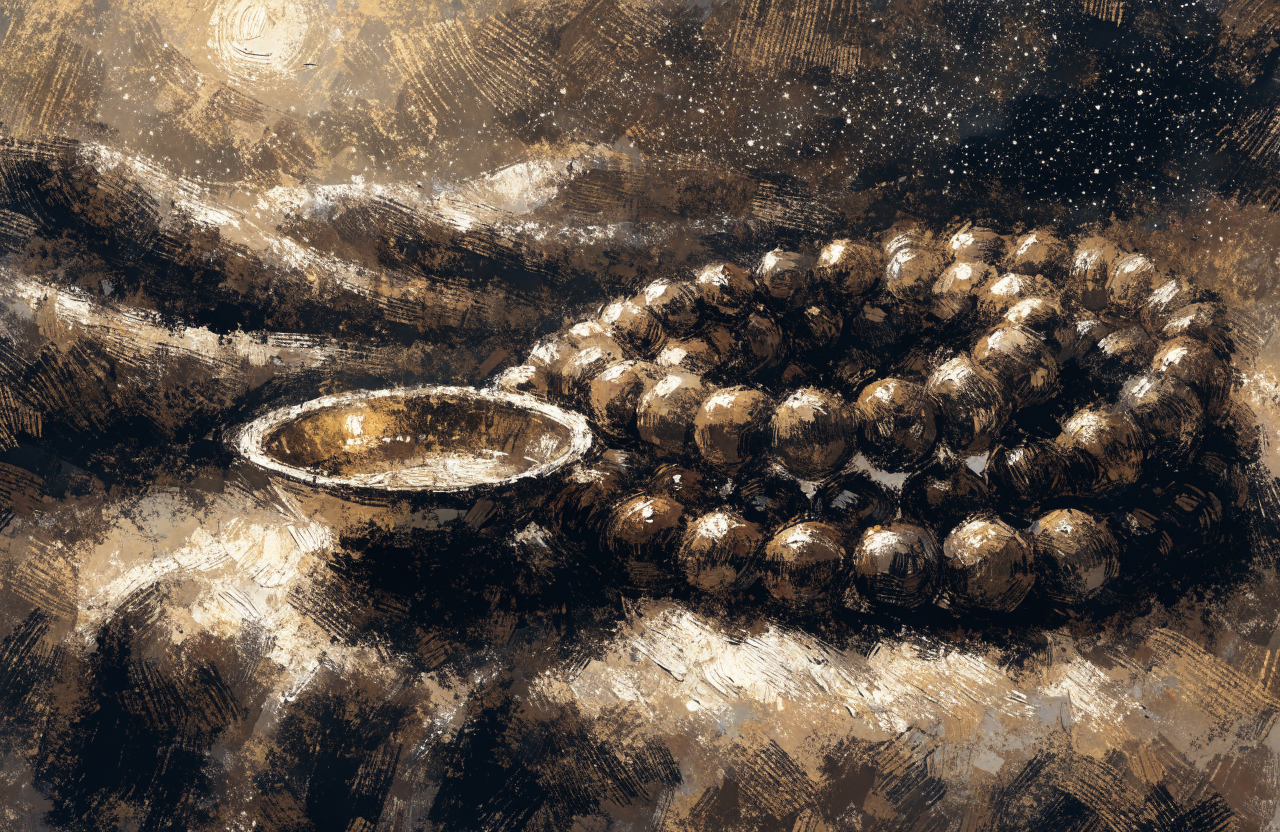
A loop of beads that your thumb rolls past, one at a time, as you repeat a name or a mantra. Count them and there are 108 — plus one larger bead, the meru, that you never cross. And 108 turns up everywhere else too: 108 names of a deity, 108 lamps, 108 steps, 108 Upaniṣads.
So — why 108? It's a fair question, and it deserves a fair answer. The surprising truth is that there is no verse anywhere that commands it. That sounds like a let-down. It isn't. Let's walk it on four levels — the meaning, the sky, the mind, and the many — and you'll see why the honest answer is the better one.
One · The meaning
A number the culture found complete
Here is the first thing to face squarely: no scripture prescribes 108 beads. The Upaniṣad actually named after the bead-string — the Akṣamālika Upaniṣad, "the Upaniṣad of the mālā" — asks for fifty beads, one for each letter of the Sanskrit alphabet. Not 108. So where did 108 come from? From everywhere and nowhere at once.
It is a number that many independent counts happen to land on, and the culture noticed:
- 108 Upaniṣads. The Muktikā Upaniṣad lists exactly 108 of them. (Though this list was drawn up late — so 108 was already the auspicious target it aimed for, not a coincidence discovered afterward.)
- 108 names of a deity. The Aṣṭottara-śata-nāmāvalī — literally "the garland of one hundred and eight names" of Viṣṇu, Śiva, or Devī. One bead, one name, one full round of remembrance.
- 27 stars × 4 = 108. The sky is mapped into 27 nakṣatras (lunar mansions), each with four quarters — 108 in all. A round of japa can be read as walking the whole sky once.
- 12 × 9 = 108. Twelve zodiac signs times nine planets; the whole cosmos, folded together.
And the plainest reason of all: 108 divides beautifully. Its factors are 1, 2, 3, 4, 6, 9, 12, 18, 27, 36, 54, 108 — twelve of them. It splits cleanly into halves (54), thirds (36), quarters (27), and the auspicious 9 and 12. That is exactly why a culture chooses a number as "complete" — and why smaller malas come as 54 or 27 beads, the same practice in the pocket or on the wrist.
No text commands 108. Many counts converge on it, and it divides like a good day. So the tradition adopted it as its number for wholeness. That's a reason for a choice — not proof of a cosmic law. And the reason a bead-string exists at all is older and simpler: the quiet, repeated turning of the mind toward the sacred. The oldest texts prize that above the grandest ritual.
विधियज्ञाज् जपयज्ञो विशिष्टो दशभिर्गुणैः ।
उपांशुः स्यात्शतगुणः साहस्रो मानसः स्मृतः ॥ ८५ ॥
vidhiyajñāj japayajño viśiṣṭo daśabhirguṇaiḥ |
upāṃśuḥ syātśataguṇaḥ sāhasro mānasaḥ smṛtaḥ || 85 ||
"Repeating the sacred name is worth ten times a ritual done by the book; said under the breath, a hundred times; and turned silently in the mind, a thousandfold."
What it means: the tradition prizes not the size of the offering but the quiet, repeated turning of the mind toward the sacred. A whispered name, a name held silently in the mind — these are ranked above the elaborate outward ceremony. The mālā is simply the tool that makes that repetition steady. And 108 is the round, "complete" number it chose to count by. The verse blesses the why of the beads; it never fixes their number.
Two · The sky
The cosmic story — real, but not exact
You will have heard the beautiful claim: 108 is a cosmic constant. The Sun sits 108 of its own widths from the Earth. The Moon sits 108 of its own widths from us. The Sun's diameter is 108 times the Earth's. Proof, people say, that the ancients had exact modern astronomy.
Let's check it honestly, against NASA's own figures — because the truth is more interesting than the slogan.
- Sun's distance ÷ Sun's width: about 107.5 on average — and it drifts across the year, from roughly 105.7 in January to 109.3 in July, as Earth's orbit swings nearer and farther. Close to 108. Not fixed at it.
- Moon's distance ÷ Moon's width: about 110.6 on average, and it swings a lot — from roughly 102 near perigee to 117 at far apogee. In the neighbourhood of 108. Nowhere near constant.
- Sun's width ÷ Earth's width: about 109, not 108.
So the coincidences are real — genuinely striking near-misses. But they are approximations that drift with the orbits, not a locked-in 108, and the Sun-to-Earth ratio is really 109. Independent fact-checkers reach the same conclusion. What's happening is ordinary and human: we remember the counts that land near 108, and quietly forget the ones that don't.
There is a real historical seed. Ancient observers noticed, with the naked eye, that a pole viewed from about 108 times its own height covers the same slice of sky as the Sun or Moon — an elegant result, accurate to a percent or two. So the sky genuinely inspired the number in a defensible way. And then the culture rounded to the 108 it already loved. That is honest astronomy. What it is not is a scientifically proven cosmic constant, and no one needs to pretend it is.
They'll tell you the Sun sits exactly 108 of its own widths from Earth — cosmic proof. Check NASA: it's about a hundred and seven and a half, and it changes all year. The coincidence is real. The word "exactly" is not.
Three · The mind
Where the real benefit lives
Set the sky aside. The genuine gift of a 108-bead mālā is not in the number — it's in what a fixed count does for a restless mind.
- A fixed count offloads the "am I done yet?" question. With 108 beads and the meru you never cross, your hand keeps the score so your mind doesn't have to. Attention is freed to rest on the mantra.
- The body keeps count, gently. One bead per repetition is a small, rhythmic, tactile loop — a mild anchor that pulls a wandering mind back, again and again. This is the well-studied mechanic behind focused-attention meditation; the bead is simply its physical form.
- Long enough to settle, short enough to finish. About 108 slow repetitions is a few unhurried minutes — long enough for breath and attention to steady, short enough to complete every day. That is what builds a habit: a bounded, repeatable ritual you can actually reach the end of.
Name the limit plainly, though: this calm comes from doing steady japa, and it would come just the same from 100 beads or 110. There is no evidence that the number 108 itself does anything to the body. 108 is the cultural container. The stillness is from the repetition and the slow breath.
Four · The many
One number, shared across traditions
108 is not only ours. It recurs in Hindu, Buddhist, and Jain practice alike — 108 beads on the string; 108 afflictions to release in Buddhism; 108 bells rung to see out the old year in Japan. A shared "complete" number lets very different communities use the same simple tool. Quietly ecumenical — ekam sat, one truth, many names.
And because 108 is fixed by custom, a mālā is instantly legible across sects and regions — a shared unit of devotion, like a standard measure. Its factors let it scale: 54 for the wrist, 27 for the pocket, the same practice made portable. It carries into all of ritual life — 108 names, 108 lamps, 108 circumambulations, 108 offerings — so a community always knows when a round of worship is whole.
So — what if you don't believe any of it?
Then ignore every symbolic count and every sky-ratio. What's left is still useful. A bead-string with a fixed stop turns a vague intention — "I'll sit quietly for a while" — into something bounded and repeatable, with a beginning, a rhythm, and an end you can reach. The number could have been 100; tradition made it 108. Either way, a counted round of slow, repeated words is one of the oldest, cheapest attention-trainers there is. You don't have to believe 108 is written in the stars to feel the mind settle by the fortieth bead.
A small practice — one quiet round
- Take any mālā. No mālā? Count on your finger-joints — the traditional 108-count runs across the segments of your fingers.
- Pick one short line that steadies you — a name, "Om", or even a plain breath-word.
- Starting at the bead beside the larger meru, say the word once per bead, unhurried — about one slow breath each.
- When you return to the meru, stop. Don't cross it. That bead means "a whole round, complete." Sit for one breath in the quiet before you rise.
- Do it once, at the same time each day. You're not counting to reach 108 — you're using 108 so you don't have to count.
108 has twelve factors. It splits into halves, thirds, quarters, ninths. That isn't mysticism — it's why a mālā can shrink to 54 or 27 and still feel whole. The tradition chose a number that divides like a good day.
No text decreed 108. The culture simply found it complete — and a number you can trust to feel whole is worth more than a cosmic law you have to fake.