Roots & Meaning · The Everyday Why
Why Do We Touch the Feet of Elders?
You lower your head — the seat of your pride — to another person's feet. It is the humblest thing a body can do. It is also one of the wisest.
The world tells you to hold your head high. Once in a while, our tradition asks you to put it near the floor — and you stand up taller for having done so.
You bend down and touch their feet.
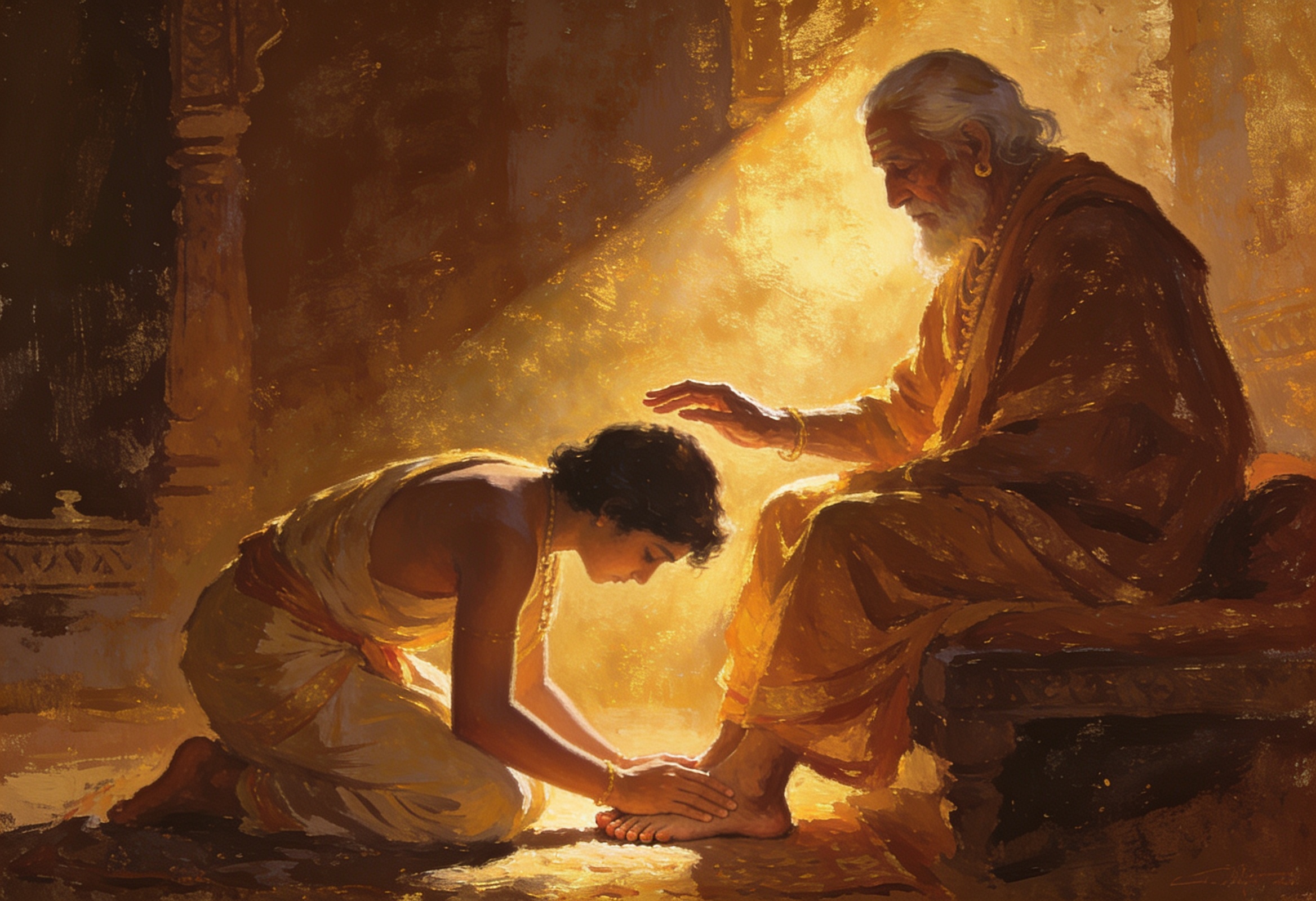
A parent, a grandparent, a teacher, an elder at a wedding. You bow, your fingers touch their feet, and a hand comes to rest on your head: "Ayuṣhmān bhava" — may you live long.
To a modern eye it can look servile. It is the opposite. Here is what is really happening — on four levels: the meaning, the mind, the family, and the culture.
One · The meaning
The highest part, laid at the lowest
Look at the geometry of it. You take the head — the seat of your ego, your intellect, your pride — and you lower it to another person's feet, the humblest point of the body. It is humility made physical: for one moment, the ego is set down.
And you bow to an elder for a reason — age carries experience, a parent and a teacher carry what you do not yet have. At the very end of a student's training, the ancient teacher's parting words were not "go and get rich." They were this:
मातृदेवो भव । पितृदेवो भव ।
आचार्यदेवो भव । अतिथिदेवो भव ॥
mātṛdevo bhava · pitṛdevo bhava
ācāryadevo bhava · atithidevo bhava
"Be one to whom the mother is as God; the father is as God; the teacher is as God; the guest is as God."
What it means: touching the feet is that instruction turned into a gesture — you honour, as sacred, the ones who gave you life and knowledge. And you do not leave empty-handed: the elder's hand comes to your head with a blessing. Grace, like water, flows downhill — you can only receive it when you lower yourself. Pride is a cup held high and closed. Humility is the same cup, held low and open.
Two · The mind
What bowing does to you
- It trains humility and gratitude. Modern psychology ties both, firmly, to wellbeing and to better relationships. A person who can bow is a person who can still learn.
- It interrupts the ego. We spend all day inflating the self. A small, regular act of lowering it is quiet medicine.
You will also hear that touching the feet transfers the elder's "energy" through some magnetic circuit. That specific claim is not established, and the practice does not need it. What it reliably produces — humility, gratitude, and a warm bond — is real, and that was always the point.
Three · The family
One bow, two gifts
This small act quietly does two things at once:
- It lifts the elder. They feel seen, honoured, still needed. That matters more than we realise — loneliness and feeling discarded in old age are now known to damage health seriously; some research compares the effect on the body to smoking.
- It grounds the young. The one who bows feels held in a line of people who came before them. Strong bonds across generations are among the best predictors of a child's stability and a family's resilience.
Few gestures give so much to both sides at the same moment.
Four · The culture
A daily vote for wisdom over noise
We live in an age obsessed with youth, one that quietly pushes its old to the edges. Touching feet is a small, daily vote the other way — for a culture that keeps its elders honoured, included, and near the centre. And a society that still bows to its elders is a society that still listens to them, so its hard-won wisdom keeps flowing down the line.
So — what if you don't believe any of it?
Then keep this much. Bowing builds real humility in you. It makes your elders feel valued — which genuinely brightens and even lengthens their lives. And it binds your family across generations. Not one of those needs a single verse to be true. The gesture simply works — on you, on them, and on the line you belong to.
A small practice
This week, touch the feet of an elder in your family — a parent, a grandparent — slowly, and mean it. If the setting makes it awkward, a sincere bow with folded hands and the same inner humility carries the same weight.
Then watch two things: what softens in them, and what settles in you.
You bend for a moment. What straightens is something inside you that had been leaning the wrong way for years.
We do not bow because we are small. We bow because we are large enough to know we did not get here alone.