Roots & Meaning · The Everyday Why
Why Do We Immerse the Idol?
For days you shape the divine from clay, feed it, sing to it, love it as family. Then you carry it to the water and let it go — with a farewell that already asks it to come again.
You made the god with your own hands, out of mud. And on the last day you give the god back to the mud. Nothing is lost. Something is learned.
The last day comes, and you know it is coming.
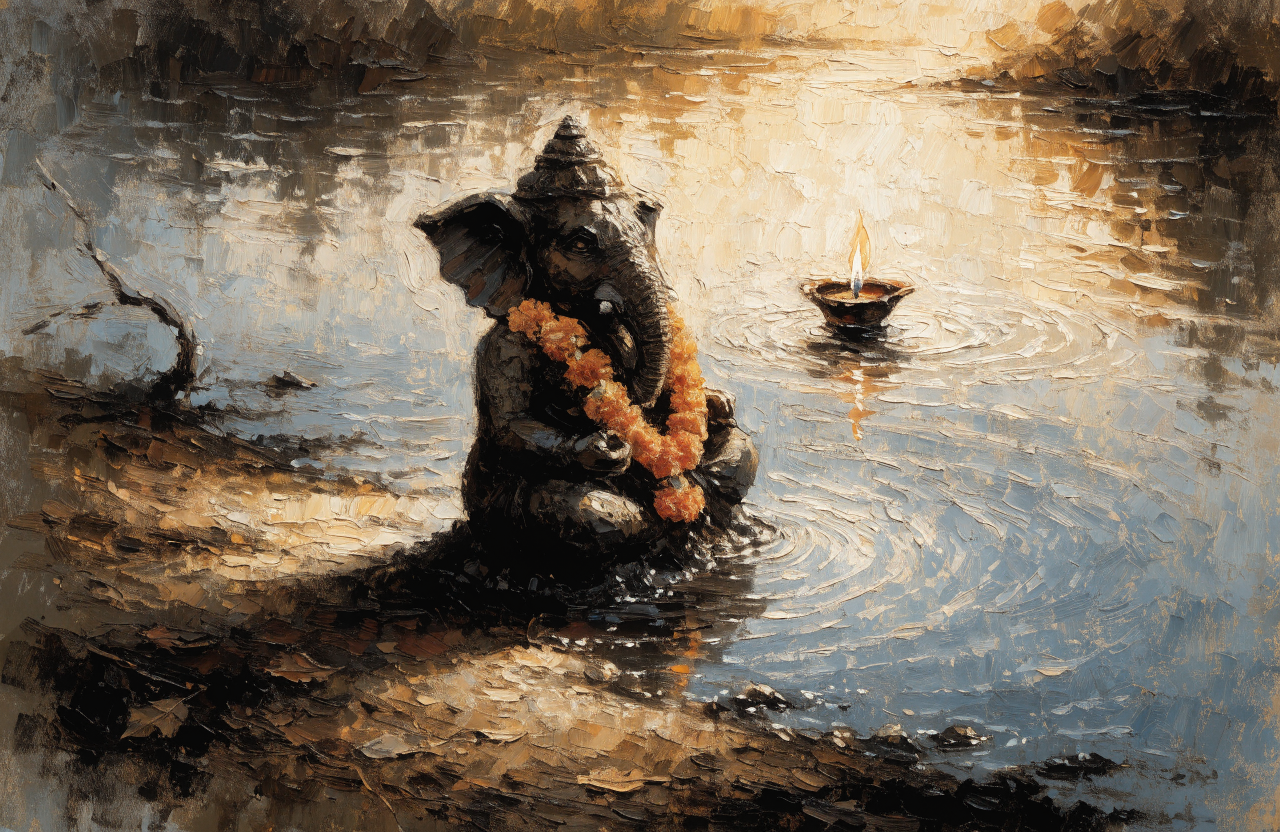
You lift the murti you have tended for days — the one you bathed, dressed, offered flowers and food, sang before, treated as a living guest in your home. You carry it to the river or the sea. And you let it go under the water. We call it visarjan — immersion.
Why build something to love, only to release it? It sounds like heartbreak arranged on purpose. In fact it is one of the wisest things the tradition ever set a whole city up to do. Here it is on four levels — the meaning, the material, the mind, and the many.
One · The meaning
You make the divine, love it, and give it back
Trace the whole arc. Clay and water become a shaped form. The deity is invoked into it (āvāhana) at the start of worship. It is served for days as an honoured guest. Then, at the end, it is dismissed (udvāsana / visarjana) and returned to the water. The form arose from the formless, and dissolves back into it. The murti was always a temporary vessel — knowingly made, knowingly released.
That is the teaching hiding in plain sight: anitya, impermanence, held gently. Everything you love is on loan and moves in a cycle. The tradition's plainest image of this is not about idols at all — it is a boy standing before Death itself, in the Kaṭha Upaniṣad, describing how all mortals pass:
अनुपश्य यथा पूर्वे प्रतिपश्य तथाऽपरे ।
सस्यमिव मर्त्यः पच्यते सस्यमिवाजायते पुनः ॥
anupaśya yathā pūrve pratipaśya tathā'pare |
sasyam iva martyaḥ pacyate sasyam ivājāyate punaḥ ||
"Look back — see how those before us passed. Look around — see how others pass now. Like a stalk of grain a mortal ripens and falls; and like grain, is born again."
What it means: everything ripens, falls, and returns to rise again. Be clear about one thing — this verse teaches human impermanence; it never mentions idols. The link to visarjan is ours, drawn by analogy: the ritual takes the verse's truth and turns it into something you can hold in your two hands. You make the form, you love it fully, and you let it go back to the water so it can come again. The verse gives the principle; visarjan is the rehearsal.
And notice what is actually whispered as the murti goes under. It is not a word of grief. It is a request:
यान्तु देवगणाः सर्वे पूजामादाय मामकीम् ।
इष्ट-काम-समृद्ध्यर्थं पुनरागमनाय च ॥
yāntu deva-gaṇāḥ sarve pūjām ādāya māmakīm |
iṣṭa-kāma-samṛddhyarthaṃ punarāgamanāya ca ||
A traditional visarjana / udvāsana mantra — a pūjā farewell, with no single canonical citation
Plainly: "May all the deities, having received my worship, now depart — and come again, for the fulfilment of what is dear." The immersion-day couplet often adds a tender line — gaccha gaccha sura-śreṣṭha svasthāne, "Go, go, O best of the gods, to your own abode …" But the one word that carries everything is punarāgamanāya — "for coming again." The goodbye already contains the next hello. On the streets of Maharashtra you hear the same thing, plainer still: "Ganpati Bappa Morya — pudhchya varshi lavkar ya," come again soon, next year. This is not loss. It is a cycle you can love.
Two · The material
"Immersion purifies the water" — and why the river needs us to look closer
Here is a belief you will hear often: that the immersion purifies the water, or charges it with the deity's energy. It is a tender thought, and for a plain clay idol it does no harm to hold it. But with the materials most idols are made of today, we owe the river the truth — and the truth runs the other way.
Scientists have gone to the immersion lakes with their instruments and simply looked. A 2014 study of three lakes in Nagpur measured what happens to the water after immersion day:
- The oxygen collapses. Dissolved oxygen fell from roughly 4–5 mg/L to under 1–2 mg/L — low enough to suffocate the fish and life in the water.
- Heavy metals climb. Lead, cadmium and copper rose in the water, several of them above the safe limits set by Indian standards.
- The poison enters the food chain. Tilapia caught from those lakes carried lead and cadmium in their muscle above safe-eating thresholds. The metals climb from the water, into the fish, onto the plate of whoever eats them.
Why? Because most modern idols are made of Plaster of Paris (POP) and finished with chemical paints. POP is not clay — it is calcium sulfate, only barely soluble, so a POP idol sits in the water for weeks and slowly leaches. The bright paints carry lead, chromium, cadmium, mercury. None of this dissolves back into the earth. It stays.
Now hold the real tension gently. A plain clay idol in a clean tank does very little harm. A POP-and-lead idol in a public lake harms it, measurably. So for the material most idols are made of today, the water is not purified but burdened — and that is worth saying plainly, out of love for both the deity and the river. The pollution is real, and it is specific.
But here is the part that is easy to miss — and it is where the tradition is on the right side of this. The old practice was cleaner. Idols were made of natural clay (śāḍu maṭṭī), coloured with natural dyes like turmeric, and — by the pollution board's own account of the old norm — the clay was often taken from the local water and returned to it. Unbaked clay simply dissolves back, harmlessly. The loop closed. "Return to the source" was not a metaphor; it was literally true. POP and synthetic paint broke that closed loop.
So the thing to name here is not the festival, and certainly not the people who love it. The threat is one narrow thing: the material choice — plaster and toxic paint, poured into large shared water. It is a material problem, and it has a material fix. Choosing clay again is not a modern compromise on the tradition. It is a recovery of what the tradition always meant.
Three · The mind
A rehearsal of the one skill nobody escapes
Everyone, eventually, has to hold something they love — and let it go on time. A person, a season, a role, a home, a life. Most of those endings are imposed on us, without warning, and they hurt more for the ambush.
Visarjan is different. It is an ending you choose. You decide when the beautiful thing ends, and you do the ending yourself, with your own hands — gently, out loud, together. That is a rare and steadying kind of agency. A structured, low-stakes, communal goodbye is exactly the kind of ritual that people across cultures use to soften a loss and mark a transition — and here you get to practise it once a year, safely, before you need the skill for real.
And notice the lesson it does not teach. It is not "don't get attached." You spend days making and loving the form precisely so that giving it back means something. The lesson is quieter and harder: love fully, cling never. You are allowed to adore a thing completely and still open your hands on time.
Four · The many
A whole city practises letting go, as one body
Walk with the procession and you see it: an entire neighbourhood grieving and celebrating the same thing, at the same moment. A hard truth — that everything ends — becomes bearable, even joyful, because nobody carries it alone. The shared "come again next year" turns a goodbye into a promise held by thousands.
There is a built-in reset in it, too. The pandal comes down. The murti returns to water. Ordinary life resumes. The festival has an honest, non-negotiable end — no hoarding, no clinging to the high, everyone starts level again. And the modern eco turn is itself a community act: choosing clay over plaster, a tank over a lake, natural dye over lead. Caring for the water is caring for the deity you are returning to it. That is how you keep "return to the source" true, and not merely said.
So — what if you don't believe any of it?
Then keep this. Visarjan is a rehearsal of the one skill nobody escapes needing — to hold something you love fully, and let it go on time — done out loud, together, with a built-in "come again" so the ending never curdles into despair. No scripture required to feel it work. And one plain, practical choice makes the whole thing honest: pick clay over plaster, and "return to the source" stops being a symbol and becomes literally true — for a real river, that a real study can measure.
A small practice
The clay-and-return, in miniature — a few minutes.
- Take a small lump of natural clay (or dough). With your own hands, shape something that means something to you — a little lamp, a leaf, a small form.
- Keep it where you'll see it for a day. Let yourself actually like it.
- Then, deliberately, dissolve it back in a bowl of water — or press it flat and return the clay to a plant's soil — and say quietly, punarāgamanāya, "come again."
- Notice the thing that surprises people: you can love something fully and let it go, and lose nothing. That is the whole skill.
And when the festival comes: choose a natural-clay idol with natural colours, and immerse it in a home bucket or a designated tank, returning the sediment to the soil. The same closed loop the tradition always meant.
The mantra you whisper as it goes under is not goodbye. It is punarāgamanāya — "come again." The farewell already holds the next hello. That is the whole secret of letting go.
You are allowed to love a thing completely, and to open your hands on time. Visarjan simply teaches you how.