Roots & Meaning · The Everyday Why
Why Do We Wear the Sacred Thread?
A thin loop of cotton, worn over one shoulder for a lifetime. Not, in the end, a badge you show — a promise you carry.
You have probably heard that the thread "channels cosmic energy," or "presses a nerve on the ear that helps digestion." It does neither. It is cotton. Its real power is stranger and older: it is a promise you can feel on your skin, all day long.
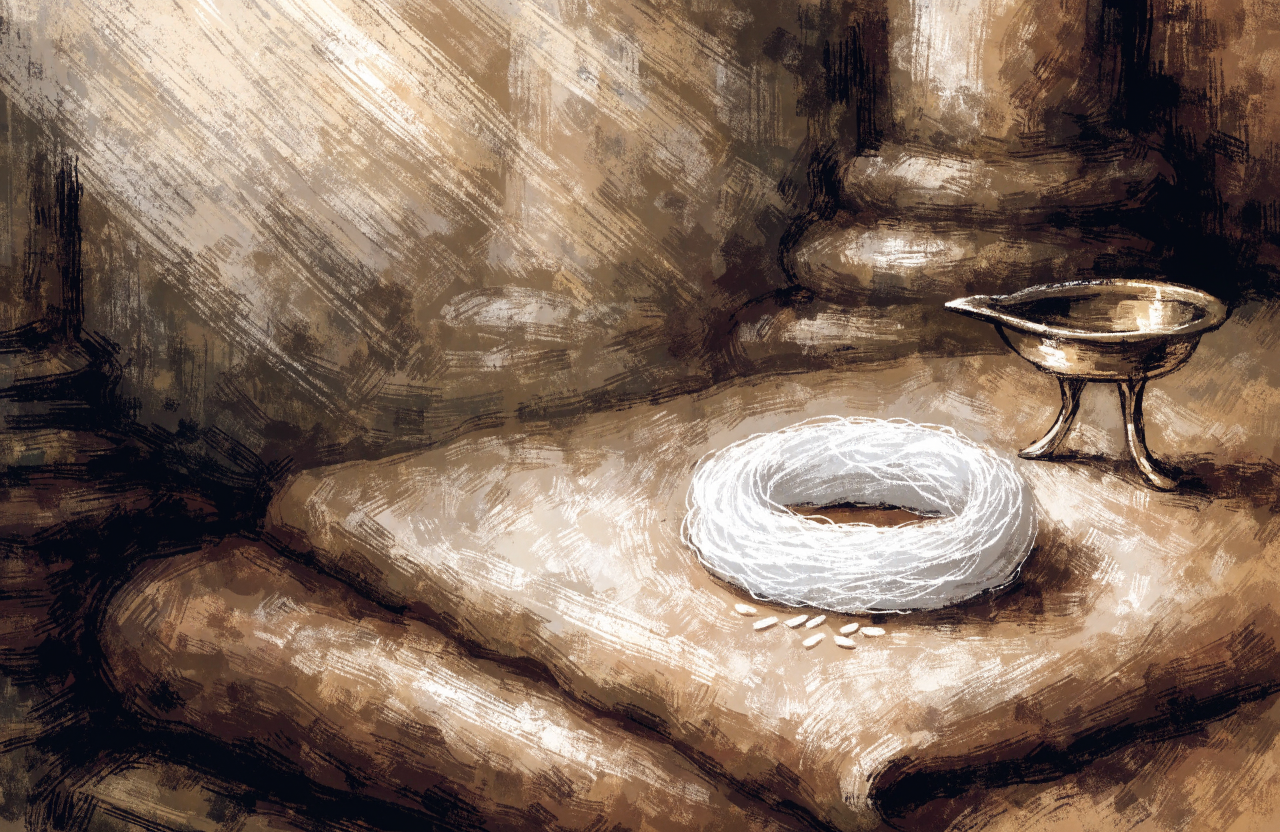
A boy sits before a fire. An elder loops a thin cord over his left shoulder.
From that day, he wears it — under the shirt, across the chest, down to the right hip. It is the yajñopavīta, the janeu, the sacred thread. Most people who wear it were never told what it is for. And most people who don't wear it assume it is a mark of rank.
Both deserve a plain answer. Here it is on four levels — the meaning, the body, the mind, and the many — with the history told straight, and nothing dressed up as science that isn't.
One · The meaning
A vow you tie onto yourself
The thread belongs to a ceremony called the upanayana — the moment a child is formally handed to learning. The tradition calls it a second birth: born once of your parents, born again into study and self-discipline. The one who takes it is dvija, "twice-born" — a phrase about a vow taken, not a family owned.
So what does the tradition's own rule-book say the cord actually is? The oldest manual of the rite — the Pāraskara Gṛhya Sūtra — spends its upanayana chapter on this ceremony. And when the cord (there, the girdle tied on with the thread) goes onto the body, the mantra spoken over it does not call it a rank. It calls it a friend.
iyaṃ duruktāt paribādhamānā varṇaṃ pavitraṃ punatī ma āgāt |
prāṇāpānābhyāṃ balam ādadhānā svasā devī subhagā mekhaleyam ||
"She has come to me — a friendly goddess, sister and guardian — driving off harsh, unworthy speech, making the wearer pure, drawing strength from the in-breath and the out-breath: this blessed girdle."
Pāraskara Gṛhya Sūtra II.2.8 — the girdle mantra of the upanayana
What it means: notice what the cord is called — a sister, a guardian, a friend — something you tie onto your own body, drawn tight by your own breath. Not a mark of who is above whom. It is there to do one job: keep ugly, careless speech out of your mouth and keep you honest. The thread is a worn vow, not a badge. A badge is worn to be seen by others. A vow is worn to be remembered by you.
You will also hear a well-loved prayer said as the thread is put on — yajñopavītaṁ paramaṁ pavitram…, "the sacred thread is supremely pure." It is a lovely, much-loved verse carried down by custom rather than tied to one classical chapter-and-verse, and it is beautiful said just as it is.
Around the cord, three quiet symbols have gathered over the centuries — offered here as symbol, not fact:
- Three debts. An old idea that we are each born owing three debts — to the sages (repaid by learning), to the ancestors (repaid by living well), and to the divine (repaid by devotion). Three strands, three reminders.
- Three by three. Others read the strands as the three guṇas, or the three great deities; the binding knot is called the brahmagranthi, "the knot of Brahman."
- A life in stages. Still others see the road ahead — the student, the householder, the elder — bound into one cord.
Two · The body
What the cord actually is
Let's be plain about the object. It is a simple twisted cotton cord, and its quiet virtues are real and completely un-mystical:
- It is light and always present — a constant physical cue on the body, the way a wedding ring or a wristband is.
- It is renewed — replaced when soiled or broken, and once a year at Upākarma. A worn thing you deliberately renew becomes a checkpoint.
- The old habit of shifting it to the ear before using the toilet, and washing before restoring it, reads best as a simple hygiene-and-mindfulness cue: I am about to do an unclean act — wash after. That much is reasonable.
You will also meet grander claims — that the thread "channels cosmic energy," "activates the Sūrya-nāḍī," or that "wearing it over the ear aids digestion" by pressing a nerve. These travel widely on lifestyle and jyotish blogs. There is nothing to reach for here: the cord doesn't need to move energy or press a nerve to be worth wearing, and it never claimed to. Its real reasons are simpler and sturdier — meaning and discipline, not medicine — and those are the ones that have kept it on the shoulder for three thousand years.
Three · The mind
A string tied around your finger — for a whole life
Here is where the thread's real power lives, and it is genuinely real. A small, constant object worn on the body is a well-known behavioural anchor. You feel it, you notice it, and in that instant it hands your commitment back to you. It is the ancient version of tying a string around your finger — except the string is tied around a life, and you feel it many times a day.
The renewal ritual adds a second, quieter genius: replacing the thread is a scheduled re-commitment. Once a year, out loud, you renew the promise. Whatever you believe, a built-in "renew your vow" checkpoint is a psychologically sound design.
And the dvija idea — that you can deliberately begin again, mark a clean before-and-after, and step into discipline on purpose — is one of the sanest frames a person can hold. Rites of passage work precisely because the body remembers the day it changed.
Four · The many
The history, told straight
This is the part that must be said plainly, because half-telling it does harm.
What was restricted
For much of the tradition, the upanayana and the sacred thread were restricted — the old manuals name only the three "studying" communities, and in practice the thread went largely to boys and men. That is real history. We do not hide it or explain it away.
What was also true — and what changed
The other half is just as real. There is genuine record of women Vedic students — the brahmavādinī — and of a time when the rite was not so narrowly drawn. And in 1875 the reformer Swami Dayananda Saraswati and the Arya Samaj deliberately reopened the sacred thread to all communities and to girls, pointing back to that earlier, wider precedent. Many families today initiate daughters alongside sons.
What it is meant to be
The whole weight of that girdle mantra is that the cord is a self-bound discipline — clean speech, study, daily practice. The moment the thread becomes a way to look down on anyone, it has been misread. The thing to guard against is a behaviour — exclusion, pride, using the cord as a wall between people — never a community. Ekam sat — truth is one. Vasudhaiva kuṭumbakam — the world is one family. A vow of discipline was never meant to be a fence.
So — what if you don't believe any of it?
Then keep this. A small object worn on the body is a reliable way to keep a promise in front of you all day — a tie-a-string-around-your-finger device for a life-vow. And a rite of passage that says "I am now responsible for my own learning and my own conduct" is a genuinely useful human ritual. A wearable, renewable vow — open to anyone who wants to take one. You need no scripture, and no energy claims, for any of that to work.
A small practice
- Put on one small thing you'll feel through the day — a thread, a band, a ring, even a knotted piece of cotton. It doesn't need to be sacred. It needs to be felt.
- Tie one specific promise to it: "clean speech today," or "ten minutes of study," or "no word behind someone's back I wouldn't say to their face."
- Each time you notice it, that is the cue — am I keeping it? At week's end, replace or re-tie it and renew the promise.
You have just borrowed the real technology of the sacred thread — a worn, renewable vow — with no need to claim it does anything to your body. And if you already wear the thread: the practice is the same. Let it mean the vow, not the rank.
For centuries only some were allowed to wear it, and reformers spent lifetimes widening that. The lesson this thread finally teaches is the opposite of pride: a vow of discipline was never meant to be a wall between people.
A badge is worn to be seen. A vow is worn to be remembered. The only real question the thread asks is not whether it has powers — but whether you keep the promise it stands for.